
The Kelly bar is the primary torque transmission component of a rotary drilling rig. Installed between the rotary drive and the drilling tool, it transfers rotational force, crowd pressure, and lifting force throughout every drilling cycle.
Although drilling buckets, core barrels, and augers perform the cutting action, their efficiency largely depends on the Kelly bar’s ability to transmit torque without excessive deformation or energy loss. An improperly selected Kelly bar can reduce penetration rates, increase wear on the rotary drive, and shorten the service life of the entire drilling system.
Modern rotary drilling rigs commonly operate with rotary heads ranging from 120 kN·m to over 450 kN·m. Large rigs used for bridge foundations and offshore piling may exceed 500 kN·m of rated torque. Under these operating conditions, the Kelly bar must withstand not only high torsional loads but also significant axial compression, tensile force during extraction, and repeated impact from changing geological formations.
The two most common Kelly bar designs used worldwide are Friction Kelly Bars and Interlocking Kelly Bars. While both perform the same basic function, their structural design, torque transmission method, and application range differ considerably.
Selecting the appropriate design according to drilling depth, geological conditions, and rig capacity can improve drilling efficiency, reduce maintenance costs, and extend equipment life.
How a Kelly Bar Transmits Torque
A Kelly bar is a telescopic assembly made of multiple nested steel sections. Most rotary drilling rigs use three to six telescopic sections, depending on the required drilling depth.
During drilling, the rotary head applies rotational torque to the outer section. This torque is transferred through the telescopic sections until it reaches the drilling tool.
At the same time, the Kelly bar must transfer:
- Rotary torque
- Crowd pressure
- Pull-out force
- Dynamic impact loads
- Bending stress caused by borehole deviation
Unlike conventional drill pipes, a Kelly bar continuously extends and retracts during drilling. This movement allows rigs with a mast height of only 18–24 m to achieve drilling depths exceeding 60–90 m without adding additional drill rods.
The design of the torque transmission system determines whether the Kelly bar is classified as friction or interlocking.
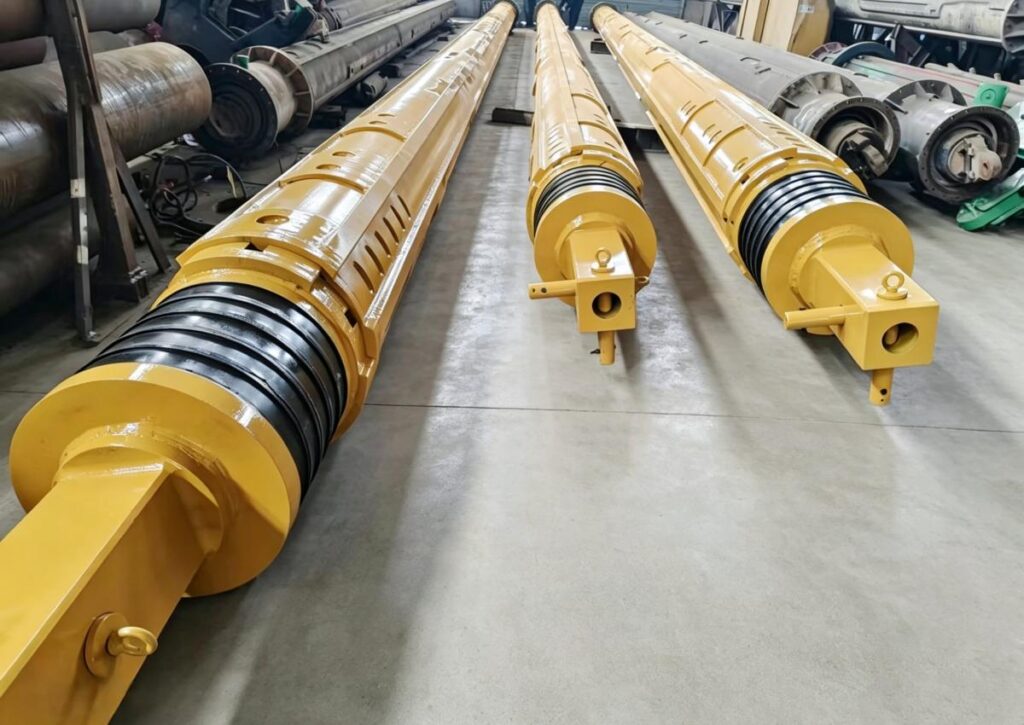
Friction Kelly Bar
A friction Kelly bar transfers torque through friction generated between the drive keys and keyways of adjacent telescopic sections.
Instead of using positive mechanical locks, the nested sections remain in continuous sliding contact. As crowd pressure is applied, the contact surfaces generate sufficient friction to transmit rotational force.
Because the sections are free to slide throughout the drilling cycle, extension and retraction occur smoothly without requiring locking engagement.
This relatively simple mechanism reduces structural complexity while allowing faster telescopic movement.
Structural Characteristics
Typical friction Kelly bars consist of:
- Three to six telescopic sections
- External drive keys
- Internal keyways
- Kelly box
- Adapter
- Wear strips
The drive keys are manufactured from high-strength wear-resistant alloy steel and are usually surface hardened to 50–55 HRC to resist continuous sliding abrasion.
Most manufacturers use seamless alloy steel tubes produced from materials such as:
| Material | Yield Strength |
|---|---|
| Q690D | ≥690 MPa |
| 27SiMn | 785–980 MPa tensile strength |
| 42CrMo | Excellent fatigue resistance |
These materials provide sufficient strength while maintaining toughness under repeated torsional loading.
Advantages of Friction Kelly Bars
The greatest advantage of a friction Kelly bar is operational efficiency in soft and medium formations.
Because no mechanical locking occurs during extension, drilling cycles are generally faster.
Benefits include:
- Smooth telescopic movement
- Lower manufacturing cost
- Reduced maintenance requirements
- Faster drilling cycles
- Lower overall weight
- Less complicated repair work
For projects involving clay, sand, silt, and weathered soil, friction Kelly bars often deliver excellent productivity.
Limitations of Friction Kelly Bars
The torque transmitted through friction depends on the contact pressure between telescopic sections.
As drilling resistance increases, microscopic sliding can occur between the drive keys, producing additional wear.
In highly abrasive formations such as granite or basalt, this wear accelerates considerably.
Common limitations include:
- Lower maximum torque capacity
- Faster drive key wear
- Reduced efficiency in hard rock
- More frequent inspection requirements
- Limited suitability for extremely deep piles
For these reasons, friction Kelly bars are generally recommended for rigs operating below approximately 250–280 kN·m of continuous drilling torque, although exact limits vary by manufacturer.
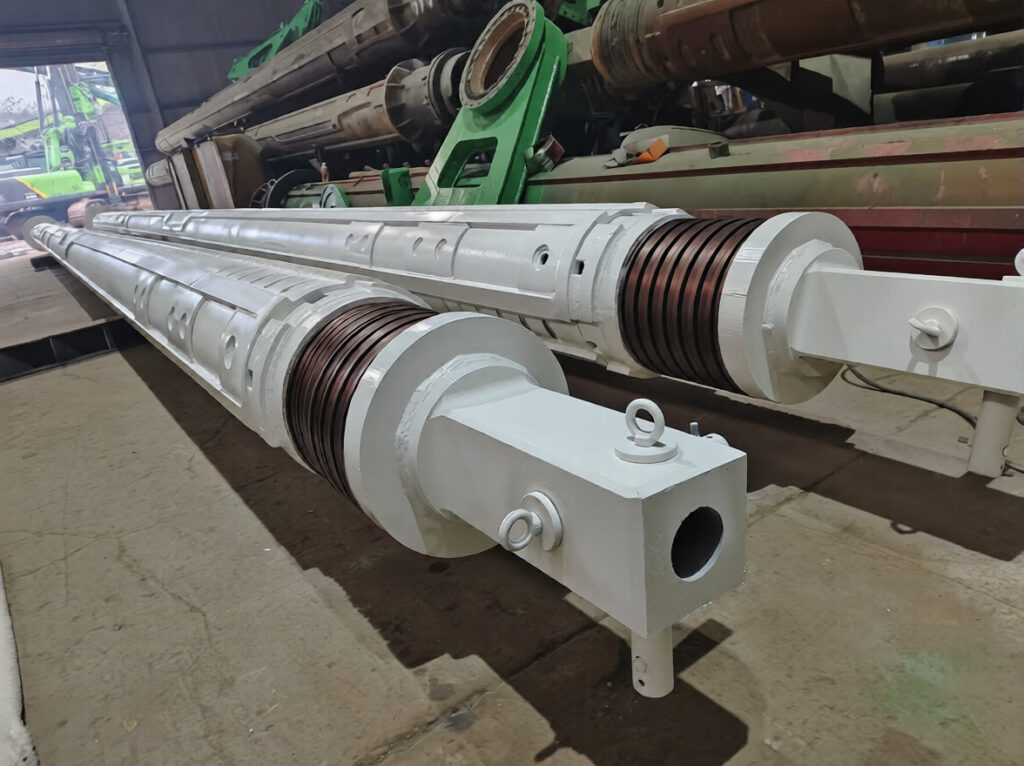
Interlocking Kelly Bar
An interlocking Kelly bar uses a completely different torque transmission principle.
Instead of relying on friction between telescopic sections, each section incorporates precision-machined locking slots.
When fully extended, adjacent sections engage mechanically.
The resulting positive connection allows torque to be transferred directly through steel-to-steel engagement.
This eliminates the possibility of slipping under high drilling resistance.
The locking mechanism significantly increases allowable torque while improving drilling stability.
Structural Characteristics
Compared with friction Kelly bars, interlocking designs include additional precision-machined components:
- Locking grooves
- Locking keys
- Reinforced drive keys
- Heavy-duty telescopic tubes
- High-strength Kelly box
Manufacturing tolerances are considerably tighter because improper alignment may prevent reliable engagement.
Most premium manufacturers machine locking surfaces using CNC equipment to maintain dimensional accuracy within fractions of a millimeter.
Advantages of Interlocking Kelly Bars
Mechanical engagement provides several important performance advantages.
Higher Torque Capacity
Because torque is transferred directly through locking shoulders rather than friction, interlocking Kelly bars withstand substantially higher torsional loads.
Typical examples include:
| Rig Class | Rotary Torque |
|---|---|
| Small rig | 120–180 kN·m |
| Medium rig | 200–280 kN·m |
| Large rig | 300–450 kN·m |
| Heavy-duty rig | 500+ kN·m |
Large foundation rigs from manufacturers such as Bauer, Soilmec, SANY, Casagrande, and XCMG commonly use interlocking Kelly bars when drilling hard rock.
Improved Stability
Mechanical locking minimizes torsional deflection.
Reduced twisting helps maintain vertical borehole alignment, particularly for:
- Bridge foundations
- High-rise buildings
- Offshore foundations
- Large diameter bored piles
Improved alignment reduces correction work and increases drilling accuracy.
Longer Service Life in Rock
Although the locking components experience concentrated stress, the drive keys experience significantly less sliding wear than friction systems.
This generally results in:
- Lower wear rate
- Longer maintenance intervals
- More consistent drilling performance
when operating in abrasive geological formations.
Mechanical Comparison
The most significant engineering difference lies in torque transmission.
Friction Kelly Bar
Torque path:
Rotary Drive → Drive Keys → Friction Contact → Next Section → Drilling Tool
Energy losses occur through microscopic sliding between contact surfaces.
Interlocking Kelly Bar
Torque path:
Rotary Drive → Locking Shoulders → Steel-to-Steel Engagement → Next Section → Drilling Tool
Virtually no slipping occurs after locking engagement.
This explains why interlocking Kelly bars can maintain stable torque even under extremely high drilling resistance.
Friction Kelly Bar vs Interlocking Kelly Bar: Engineering Comparison
Selecting a Kelly bar should be based on drilling conditions, rig specifications, and project requirements rather than purchase price alone. While friction Kelly bars perform efficiently in soft and medium formations, interlocking Kelly bars provide greater reliability when drilling deep piles or hard rock formations.
The following comparison highlights the key technical differences.
| Specification | Friction Kelly Bar | Interlocking Kelly Bar |
|---|---|---|
| Torque Transmission | Friction between drive keys | Mechanical locking |
| Rated Torque Capacity | 120–280 kN·m | 250–500+ kN·m |
| Maximum Drilling Depth* | 45–75 m | 60–120 m |
| Telescopic Movement | Continuous sliding | Locking and sliding |
| Drilling Cycle Speed | Faster | Slightly slower |
| Hard Rock Capability | Moderate | Excellent |
| Drive Key Wear | Higher | Lower |
| Structural Complexity | Simple | More complex |
| Maintenance Cost | Lower | Moderate |
| Typical Applications | Soil and mixed formations | Hard rock and deep foundations |
*Actual drilling depth depends on the drilling rig, Kelly bar configuration, and geological conditions.
Performance in Different Ground Conditions
Ground conditions have the greatest influence on Kelly bar selection. As drilling resistance increases, the demand for higher torque transmission also increases.
| Ground Condition | Recommended Kelly Bar |
|---|---|
| Clay | Friction |
| Sand | Friction |
| Silt | Friction |
| Soft Gravel | Friction |
| Dense Gravel | Friction / Interlocking |
| Weathered Rock | Interlocking |
| Limestone | Interlocking |
| Granite | Interlocking |
| Basalt | Interlocking |
In soft formations such as clay and sand, drilling resistance is relatively low. A friction Kelly bar provides smooth extension and shorter drilling cycles, improving productivity.
In hard rock formations, drilling tools require substantially higher torque to maintain penetration. Mechanical locking prevents energy loss and allows the rotary drive to deliver its full drilling capacity.
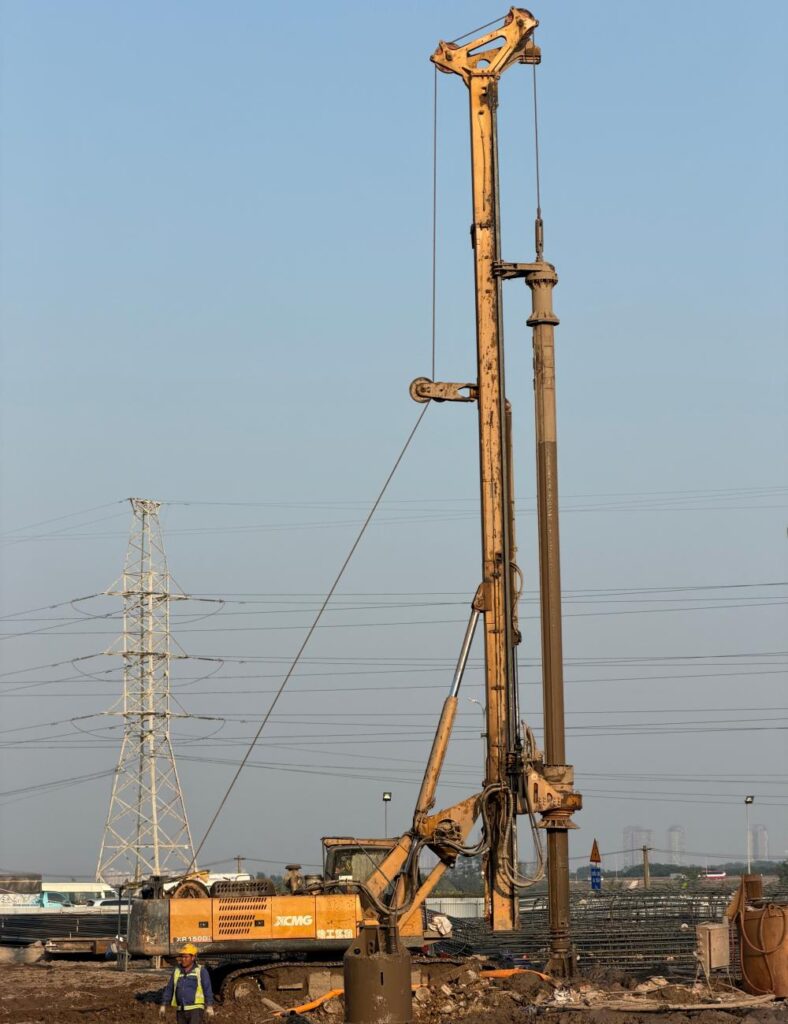
Drilling Efficiency Comparison
The drilling speed of a rotary drilling rig depends on several factors, including rotary torque, crowd force, drilling tools, and geological conditions. The Kelly bar also influences overall efficiency by determining how effectively torque reaches the drilling tool.
Field experience from foundation contractors indicates the following general trends.
Soft Soil
Typical penetration rate:
- Friction Kelly Bar: 8–15 m/hour
- Interlocking Kelly Bar: 7–14 m/hour
The difference is relatively small because drilling resistance remains low.
Mixed Ground
Typical penetration rate:
- Friction Kelly Bar: 4–8 m/hour
- Interlocking Kelly Bar: 5–9 m/hour
Mechanical locking begins to demonstrate its advantage as rock content increases.
Hard Rock
Typical penetration rate:
- Friction Kelly Bar: 0.5–2.0 m/hour
- Interlocking Kelly Bar: 1.5–3.5 m/hour
The higher torque transmission efficiency of an interlocking Kelly bar can significantly improve penetration rates in competent rock formations, especially when used with rock buckets or core barrels.
Actual drilling performance varies depending on rock strength, drilling tools, and rig specifications.
Service Life and Maintenance
Kelly bars operate under repeated torsional and axial loading, making routine inspection essential regardless of design.
Friction Kelly Bar Maintenance
Routine inspections should include:
- Drive key wear
- Keyway clearance
- Tube straightness
- Weld inspection
- Kelly box wear
Since drive keys remain in continuous sliding contact, they typically experience higher wear rates than interlocking systems.
Wear strips should be replaced before excessive clearance develops, as increased play can reduce drilling accuracy and accelerate component wear.
Interlocking Kelly Bar Maintenance
Additional inspections include:
- Locking shoulder wear
- Locking slot deformation
- Engagement accuracy
- Key alignment
- Structural cracking
Although interlocking Kelly bars contain more components, drive key wear is generally lower because torque is transmitted primarily through the locking mechanism rather than continuous friction.
Proper lubrication of sliding surfaces remains important for both designs.
Matching the Kelly Bar to the Rotary Drilling Rig
Kelly bars should always match the drilling rig’s technical specifications.
Key parameters include:
- Rotary torque
- Crowd force
- Pull-down force
- Main winch capacity
- Kelly box dimensions
- Maximum drilling depth
For example:
| Rig Model | Typical Torque | Recommended Kelly Bar |
|---|---|---|
| SANY SR155 | 155 kN·m | Friction |
| SANY SR235 | 235 kN·m | Friction / Interlocking |
| SANY SR285 | 285 kN·m | Interlocking |
| Bauer BG30 | 300 kN·m | Interlocking |
| XCMG XR360 | 360 kN·m | Interlocking |
Always verify the Kelly bar dimensions and connection type with the drilling rig manufacturer before installation.
Cost Analysis
Initial purchase price is only one part of the total operating cost.
| Cost Factor | Friction | Interlocking |
|---|---|---|
| Initial Investment | Lower | Higher |
| Drilling Speed in Soft Soil | Excellent | Good |
| Drilling Speed in Rock | Moderate | Excellent |
| Drive Key Replacement | More Frequent | Less Frequent |
| Maintenance Complexity | Lower | Moderate |
| Long-Term Operating Cost in Hard Rock | Higher | Lower |
For contractors working primarily in clay, sand, and general foundation projects, friction Kelly bars often provide the best return on investment.
For bridge foundations, high-rise buildings, and rock drilling, interlocking Kelly bars typically reduce total operating costs by improving drilling efficiency and extending component life.
Selecting the Right Kelly Bar
Before purchasing a Kelly bar, contractors should evaluate the following factors:
- Maximum rotary torque of the drilling rig
- Required drilling depth
- Geological conditions
- Pile diameter
- Drilling tools to be used
- Maintenance capability
- Project duration
Choosing a Kelly bar that is too light for the application may result in excessive wear and reduced productivity. Conversely, using a heavy-duty interlocking Kelly bar for routine soft-soil drilling may increase equipment costs without delivering significant performance benefits.
Frequently Asked Questions
Interlocking Kelly bars are the preferred choice because their mechanical locking system provides higher torque transmission and improved stability in granite, basalt, limestone, and other hard rock formations.
Yes. Friction Kelly bars can drill through weathered rock and some medium-hard formations. However, drilling efficiency decreases as rock strength increases, making interlocking Kelly bars more suitable for demanding conditions.
Friction Kelly bars have a simpler structure and lower maintenance requirements. Interlocking Kelly bars require inspection of the locking mechanism but generally experience less drive key wear during heavy-duty drilling.
Most rotary drilling rigs use Kelly bars with 3 to 6 telescopic sections, depending on the required drilling depth and rig configuration.
The correct Kelly bar should match the drilling rig’s torque output, drilling depth, geological conditions, Kelly box dimensions, and drilling tools. Selecting the appropriate design improves drilling efficiency and extends equipment service life.