
Selecting a suitable vibro hammer is not simply a matter of choosing the largest available model. The performance of a vibratory piling system depends on how well the hammer is matched to the pile, ground conditions, required penetration depth, hydraulic system, and carrier.
An undersized vibro hammer may result in slow penetration, excessive operating time, or failure to reach the required depth. On the other hand, selecting a hammer with unnecessarily high capacity can increase equipment cost, hydraulic requirements, and operating expenses without providing a practical benefit.
For contractors and equipment buyers, a systematic selection process is therefore important. The most suitable vibro hammer should provide sufficient dynamic performance for the specific pile and ground conditions while remaining compatible with the available excavator, crane, clamp, and hydraulic power pack.
Start With the Pile Specification
The pile is one of the first factors to consider when selecting a vibro hammer.
Different pile sections have different weights, stiffness, surface areas, and gripping requirements. These characteristics directly affect the dynamic load that the hammer needs to generate.
Important pile parameters include:
- Pile type
- Pile weight
- Pile length
- Pile diameter or cross-sectional dimensions
- Wall thickness
- Required penetration depth
- Pile material
- Connection and gripping requirements
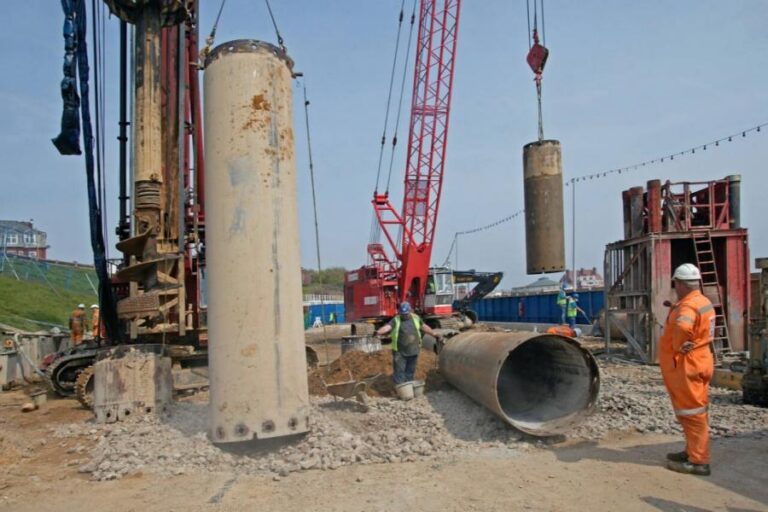
Common pile types used with vibratory piling equipment include:
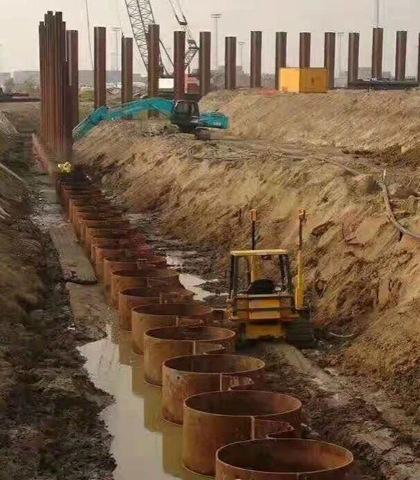
- Steel sheet piles
- Steel pipe piles
- H-piles
- Steel casings
- Other temporary steel piling elements
A longer or heavier pile does not automatically require the largest vibro hammer. The actual requirement depends on the resistance developed by the surrounding ground and the characteristics of the pile.
Evaluate the Soil Profile Before Choosing the Hammer
Ground conditions can have a greater influence on vibro hammer selection than the nominal pile size.
A project may contain several soil layers, and penetration performance can change significantly as the pile passes from one layer to another.
Important ground conditions include:
- Loose sand
- Dense sand
- Silt
- Soft clay
- Stiff clay
- Gravel
- Mixed soil
- Fill material
- Weathered formations
Granular Soils
Vibratory piling equipment is generally well suited to granular soils because vibration can help reduce resistance between the pile surface and surrounding soil.
Loose to medium-dense sand can often provide favorable conditions for vibratory installation.
As density increases, however, the required hammer performance may also increase.
Cohesive Soils
Clay behaves differently from granular soil.
In cohesive ground, the pile may experience significant adhesion along its shaft. The degree of resistance depends on the clay properties, pile surface, depth, and drainage conditions.
Soft clay may allow relatively easy penetration, while stiff clay can require substantially greater equipment capacity.
Gravel and Mixed Ground
Gravel can present a more complicated condition because particle size, density, and the presence of larger obstructions can affect penetration.
Where large cobbles, boulders, or hard layers are present, a vibro hammer may not be sufficient by itself. Pre-drilling or another installation method may need to be considered.
For this reason, the complete geotechnical profile should be reviewed rather than selecting equipment based only on the soil type at the surface.
Consider Required Penetration Depth
The required installation depth is another important selection factor.
A pile that can be installed easily during the first few meters may encounter significantly higher resistance at greater depth. Soil density, overburden pressure, shaft friction, and changes in the geological profile can all influence penetration.
For example, a project may have:
0–5 m: Loose sand
5–12 m: Dense sand
12–18 m: Gravelly soil
In this situation, selecting a vibro hammer based only on the upper loose layer could result in insufficient performance when the pile reaches the deeper dense layer.
The selection should therefore consider the most demanding section of the planned pile installation, not just the initial penetration stage.
Understand Centrifugal Force
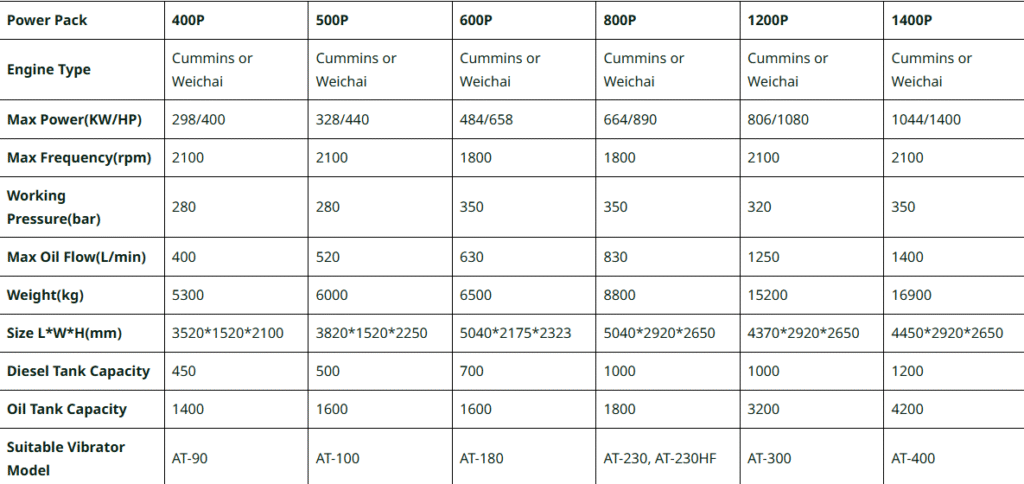
Centrifugal force is one of the key specifications used when comparing vibro hammer models.
It represents the dynamic force generated by the rotating eccentric system and is normally expressed in kN.
Higher centrifugal force can provide greater driving capability, but it should not be interpreted as the only indicator of hammer performance.
Two vibro hammers with similar centrifugal force can have different operating characteristics because other parameters, such as eccentric moment, frequency, static weight, hydraulic power, and clamp configuration, also affect performance.
When comparing models, centrifugal force should therefore be considered together with the other technical specifications.
Check the Eccentric Moment
Another important specification is the eccentric moment, often expressed in kg·m.
The eccentric moment describes the rotating mass distribution responsible for generating vibration.
In general, a greater eccentric moment can produce stronger dynamic action, but the relationship between eccentric moment, frequency, centrifugal force, and operating conditions needs to be considered as a complete system.
A professional equipment selection should therefore avoid comparing machines using centrifugal force alone.
When reviewing technical data, contractors should look at:
- Centrifugal force
- Eccentric moment
- Operating frequency
- Amplitude
- Static weight
- Hydraulic power
These specifications provide a better basis for comparing vibro hammer models.
Match the Operating Frequency to the Application
Vibration frequency is another important specification.
Frequency describes how many vibration cycles the hammer produces per minute. Different ground conditions and pile configurations may respond differently to vibration frequency.
A hammer with variable frequency can provide greater flexibility because the operating frequency can be adjusted according to the installation conditions.
Frequency selection can also become important when working near existing buildings, underground structures, utilities, or other vibration-sensitive facilities.
The objective is not simply to choose the highest frequency. Instead, the selected equipment should provide an operating range appropriate for the project and the manufacturer’s recommended working conditions.
Consider Vibration Amplitude
Amplitude describes the magnitude of the vibration movement generated by the eccentric system.
Together, frequency and amplitude determine important characteristics of the vibratory system.
When selecting a vibro hammer, contractors should consider whether the equipment provides:
- Fixed amplitude
- Variable amplitude
- Fixed frequency
- Variable frequency
The appropriate combination depends on the hammer design and the intended application.
For equipment selection, it is better to evaluate the manufacturer’s complete performance data rather than assuming that a higher amplitude or frequency is always better.
Select the Correct Clamp
The clamp is the connection between the vibro hammer and the pile. It must be suitable for the pile profile and capable of maintaining a secure grip during operation.
Different applications may require different clamp configurations.
Sheet Pile Clamp
Designed for gripping sheet pile sections and maintaining stable contact during installation and extraction.
Pipe Pile Clamp
Designed to grip cylindrical steel piles or casings.
The clamp must accommodate the required pile diameter and provide sufficient gripping capacity.
H-Pile Clamp
Used where the pile has an H-shaped cross-section. The clamp geometry must match the profile of the pile.
Side-Grip Clamp
Side-grip systems can be useful where access or pile configuration makes conventional top gripping unsuitable.
Clamp selection should consider:
- Pile profile
- Pile dimensions
- Maximum pile weight
- Required gripping force
- Installation depth
- Extraction requirements
A powerful vibro hammer cannot perform effectively if the clamp cannot maintain a reliable connection with the pile.
Check Hydraulic Flow and Pressure
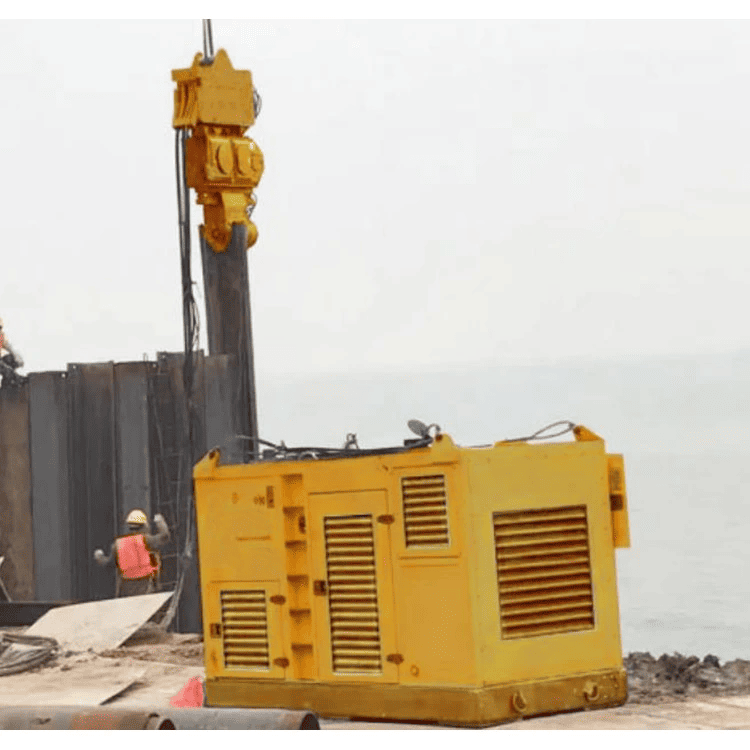
For a hydraulic vibro hammer, the carrier or power pack must provide the required hydraulic flow and operating pressure.
This is one of the most commonly overlooked points when matching equipment.
Before connecting a vibro hammer to an excavator or hydraulic power pack, check:
- Required hydraulic flow
- Operating pressure
- Maximum pressure
- Hydraulic return-line requirements
- Hose size
- Hydraulic oil compatibility
- Cooling capacity
For example, an excavator may have sufficient lifting capacity but still be unsuitable if its hydraulic flow or pressure does not meet the hammer manufacturer’s requirements.
Therefore:
Carrier lifting capacity and hydraulic compatibility must both be checked.
Match the Vibro Hammer With the Carrier
The supporting machine also affects the performance of the complete piling system.
Depending on the equipment configuration, a vibro hammer may be mounted on:
- Excavators
- Crawler cranes
- Piling rigs
- Specialized carriers
When using an excavator, consider:
- Rated operating weight
- Hydraulic flow
- Hydraulic pressure
- Lifting capacity
- Boom configuration
- Working radius
- Stability
For crane-suspended applications, the crane must have sufficient capacity to safely handle the combined weight of the hammer, clamp, pile, and associated equipment at the required working radius.
The carrier should not be selected solely according to the weight of the vibro hammer.
Installation and Extraction Requirements
A vibro hammer may be used for both installation and extraction, but the equipment requirements are not necessarily identical for every project.
For pile extraction, contractors should consider:
- Pile length
- Embedded depth
- Soil adhesion
- Pile weight
- Time in service
- Potential soil locking
- Required extraction force
Temporary piles that remain in the ground for an extended period may develop greater resistance than newly installed piles.
Therefore, a hammer selected only for the original installation task may not necessarily provide sufficient extraction performance.
If both installation and extraction are required, the selection should consider the more demanding operation.
Consider Pile Weight and Hammer Static Weight
The relationship between the pile and the hammer is also important.
A vibro hammer has its own static weight, while the pile has its own mass. During operation, the dynamic system must remain stable and transfer vibration effectively to the pile.
For larger and heavier piles, a heavier hammer may be required to provide an appropriate dynamic system.
However, increasing hammer weight alone does not guarantee better performance.
The overall combination of:
Hammer Weight + Eccentric Moment + Centrifugal Force + Frequency + Clamp + Hydraulic Power
should be evaluated as a complete system.
Match the Hammer to the Project’s Production Requirements
Equipment selection should also consider the required production rate.
For projects involving hundreds or thousands of meters of pile installation, a hammer that operates efficiently under the expected ground conditions can have a significant effect on overall project productivity.
Consider:
- Required installation depth
- Number of piles
- Average pile length
- Expected installation time
- Working hours per day
- Required extraction rate
- Number of machines available
A slightly higher-capacity machine may sometimes be justified if it significantly improves installation productivity. However, excessive equipment capacity can increase transportation, fuel, hydraulic, and operating costs.
The goal is to select the right capacity, rather than simply the maximum capacity.
Example: Selecting a Vibro Hammer for Different Pile Conditions
Consider three simplified project conditions:
| Project Condition | Pile Type | Ground Condition | Main Selection Considerations |
|---|---|---|---|
| Temporary excavation support | Steel sheet pile | Loose to medium sand | Moderate centrifugal force, suitable sheet pile clamp |
| Bridge foundation | Steel pipe pile | Dense sand and gravel | Higher dynamic capacity, appropriate pipe clamp, sufficient carrier capacity |
| Temporary casing installation | Steel casing | Soft to medium soil | Suitable clamp, hydraulic compatibility, extraction capability |
These examples show why there is no universal vibro hammer specification suitable for every project.
The same hammer may perform very differently when the pile type or geological conditions change.
Vibro Hammer Selection Checklist
Before purchasing or renting a vibro hammer, collect the following project information:
Pile Information
- Pile type
- Pile dimensions
- Pile weight
- Pile length
- Required installation depth
- Required extraction depth
Ground Information
- Soil classification
- Soil density or consistency
- Geological profile
- Groundwater conditions
- Presence of gravel, cobbles, or hard layers
Equipment Information
- Required centrifugal force
- Eccentric moment
- Operating frequency
- Amplitude
- Hydraulic flow
- Hydraulic pressure
- Static weight
- Clamp capacity
Carrier Information
- Excavator or crane model
- Lifting capacity
- Hydraulic specifications
- Working radius
- Available power pack
Project Requirements
- Installation rate
- Extraction requirements
- Site restrictions
- Vibration-sensitive surroundings
- Transportation and operating costs
Having this information available allows suppliers and contractors to recommend a more suitable vibro hammer configuration.
Conclusion
Choosing the right vibro hammer requires more than comparing maximum centrifugal force or hydraulic power. The equipment must be matched to the complete installation system, including the pile type, pile weight, ground conditions, penetration depth, eccentric moment, operating frequency, clamp, hydraulic system, and carrier.
For straightforward conditions, a standard vibro hammer may provide an efficient solution. More demanding projects involving heavy pipe piles, dense ground, deep penetration, or pile extraction require a more detailed technical assessment.
The best approach is to provide the equipment supplier with the pile specifications, geological information, required depth, and available carrier details before selecting a model. This helps ensure that the vibro hammer has sufficient performance for the actual project without unnecessary equipment capacity.
Frequently Asked Questions(FAQ)
Choose a vibro hammer based on pile type and dimensions, soil conditions, required driving depth, pile weight, centrifugal force, eccentric moment, frequency, clamp configuration, and hydraulic requirements. The hammer should also be compatible with the carrier or crane.
Vibro hammers are generally most effective in granular soils such as sand and gravel, particularly loose to medium-dense formations. Dense sand, hard clay, gravel layers, and cemented soils may require a larger hammer, pre-drilling, or an alternative installation method.
Different piles require different clamp configurations and hammer capacities. Sheet piles typically use sheet-pile clamps, while steel pipe piles and larger sections may require stronger or double-clamp systems. Pile weight, diameter, cross-section, length, and required penetration depth should all be considered.
Eccentric moment describes the rotating eccentric mass and its offset, while centrifugal force is the dynamic force generated during rotation. Both parameters influence pile penetration, but they should be evaluated together with operating frequency, pile characteristics, and soil resistance rather than used as isolated selection criteria.
Check the required hydraulic oil flow, operating pressure, hydraulic power, and hose connections. For excavator-mounted applications, the excavator’s auxiliary hydraulic circuit must meet the hammer manufacturer’s flow and pressure requirements. Insufficient hydraulic flow can prevent the hammer from reaching its designed operating performance.