Continuous Flight Auger (CFA) piling is a widely used foundation method for constructing deep foundations without leaving an open borehole during drilling. The method combines continuous auger drilling with concrete placement, allowing the pile to be formed while the borehole remains supported by the surrounding soil.
For contractors working on commercial buildings, infrastructure, bridges, and other foundation projects, understanding the continuous flight auger pile construction process, equipment requirements, and ground conditions is important for achieving consistent pile quality and productivity.
What Is a Continuous Flight Auger Pile?
A continuous flight auger pile is a cast-in-place concrete pile constructed using a long continuous auger. Unlike conventional bored piling, the auger remains in the ground during drilling and helps support the surrounding soil.
Once the required depth is reached, concrete is pumped through the hollow stem of the auger while the auger is gradually withdrawn. This creates the pile without requiring an open excavation.
The method is also commonly referred to as CFA piling or continuous flight auger piling.

How Does Continuous Flight Auger Pile Construction Work?
CFA pile construction generally consists of four main stages:
- Positioning the drilling rig at the designated pile location.
- Drilling the continuous flight auger to the specified depth.
- Pumping concrete through the hollow auger stem while withdrawing the auger.
- Installing reinforcement into the freshly placed concrete.
The continuous nature of the process reduces the time that the borehole is exposed. This can be particularly useful where loose or unstable soil could cause an unsupported borehole to collapse.
Key Equipment for Continuous Flight Auger Pile Construction
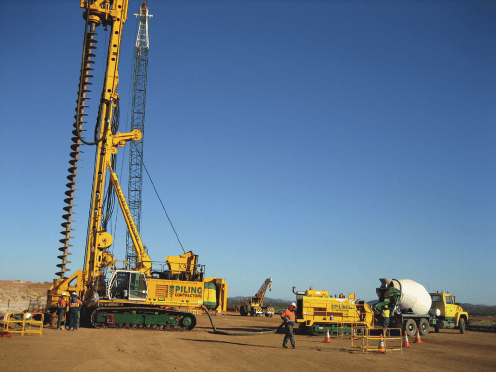
A CFA piling system requires more than just the auger itself. The drilling rig, auger, concrete delivery system, and reinforcement equipment must work together to maintain the required pile geometry and construction parameters.
CFA Drilling Rig
A CFA drilling rig provides the torque, crowd force, rotation, and lifting capacity required to advance the auger and extract it during concrete placement.
Rig selection depends on factors such as:
- Required pile diameter
- Maximum pile depth
- Soil conditions
- Auger length
- Required drilling torque
- Concrete pumping requirements
For deep or large-diameter piles, sufficient torque and extraction capacity are particularly important.
Continuous Flight Auger
The continuous flight auger consists of a continuous helical flight welded around a central stem. During drilling, the flights transport excavated soil toward the surface while the stem maintains the connection between the drilling head and the rig.
Auger configuration should be selected according to the formation.
For example:
- Clay and cohesive soil: standard soil auger configurations can provide efficient cutting and spoil removal.
- Sand and loose soil: suitable flight geometry helps maintain drilling efficiency.
- Gravel and mixed ground: reinforced cutting components may be required.
- Harder formations: specialized teeth or rock-oriented drilling tools may be necessary.
The cutting teeth are particularly important because they directly engage with the formation and are subject to significant wear.
Concrete Pumping System
Concrete is delivered through the hollow center of the auger. During auger withdrawal, the concrete pump must maintain an appropriate flow rate to ensure that the excavated space is continuously filled.
Poor coordination between auger extraction speed and concrete delivery can affect pile integrity.
Reinforcement Cage
Depending on the structural design, reinforcement may be inserted into the freshly placed concrete after auger withdrawal.
The cage must be installed carefully to achieve the required depth and alignment without disturbing the concrete column.
Continuous Flight Auger Pile Construction Process
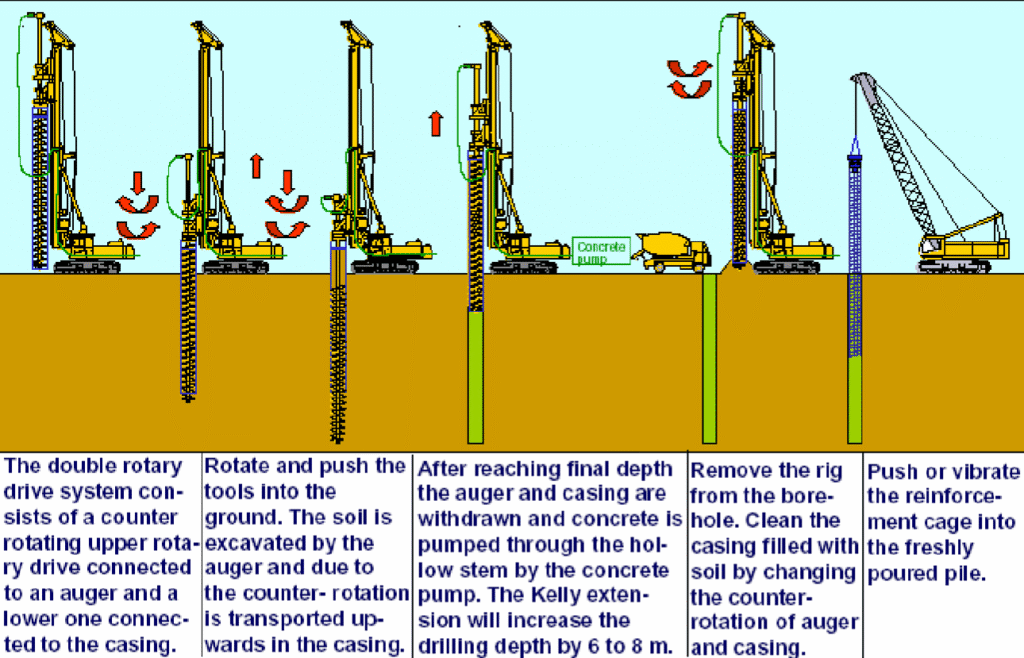
1. Site Preparation and Positioning
Before drilling begins, the pile location is surveyed and the working platform is prepared to support the CFA rig safely.
The rig is then positioned vertically over the pile center.
2. Auger Drilling
The continuous flight auger is rotated and pushed into the ground until the required pile depth is reached.
Unlike open-hole drilling, excavated material remains supported by the auger flights as the tool advances.
During this stage, operators monitor parameters such as:
- Drilling depth
- Rotation speed
- Torque
- Crowd force
- Penetration rate
These values can help identify changes in ground conditions during drilling.
3. Concrete Placement and Auger Extraction
Once the target depth is reached, concrete pumping begins.
The auger is gradually withdrawn while concrete is continuously discharged through the hollow stem. The withdrawal rate must be coordinated with the concrete delivery rate to maintain sufficient pressure and avoid creating voids in the pile.
This is one of the most important stages of CFA pile construction.
4. Reinforcement Installation
After concrete reaches the required pile level, the reinforcement cage is inserted into the fresh concrete.
Depending on the pile diameter, cage length, concrete properties, and installation conditions, contractors may use different methods to achieve the required reinforcement depth.
5. Pile Head Preparation
After the concrete has reached the required condition, the pile head can be prepared for connection with the pile cap or other foundation elements.
The final pile must meet the specified requirements for:
- Diameter
- Depth
- Concrete volume
- Reinforcement
- Position
- Verticality
Continuous Flight Auger Piles in Different Ground Conditions
One of the main advantages of CFA piling is its ability to construct piles efficiently without leaving an open borehole.
Cohesive Soil
CFA piling generally performs well in cohesive soils such as clay. The continuous auger can efficiently remove the excavated material while maintaining the borehole geometry.
Sand and Loose Soil
Loose sand can be more challenging because of its tendency to collapse or flow into an unsupported borehole. Keeping the auger in the ground until concrete placement helps reduce this risk.
Gravel and Mixed Ground
Gravel, cobbles, and mixed formations can increase cutting resistance and accelerate tooth wear. The auger and cutting teeth should therefore be selected according to the size and abrasiveness of the material.
Groundwater
High groundwater levels can create additional challenges during foundation construction. Because concrete is placed as the auger is withdrawn, CFA piling can reduce the time that an unsupported borehole is exposed to groundwater-related instability.
However, actual suitability depends on the soil profile, pile depth, concrete mix, and equipment configuration.
Applications of Continuous Flight Auger Piles
Continuous flight auger piles are commonly used where low vibration, efficient production, and reliable cast-in-place foundations are required.
Typical applications include:
- Commercial and residential buildings
- Industrial facilities
- Warehouses
- Bridge and infrastructure projects
- Retaining structures
- Highway construction
- Foundation reinforcement
- Projects near existing buildings
The relatively low vibration generated by CFA drilling can make the method attractive for urban construction where conventional driven piles may create excessive ground vibration.
Advantages of Continuous Flight Auger Piling
CFA piling offers several practical advantages:
Fast Production
Because drilling and concrete placement are integrated into one continuous process, pile installation can be relatively fast when suitable equipment and ground conditions are available.
Reduced Borehole Exposure
The auger remains in the ground during drilling, reducing the period in which the surrounding soil is unsupported.
Low Vibration
Compared with driven pile installation, CFA piling generally produces lower vibration, which can be beneficial near sensitive structures.
Suitable for Urban Projects
The combination of relatively low vibration and efficient spoil handling makes CFA piling suitable for many urban foundation projects.
Flexible Pile Dimensions
Different auger diameters and drilling configurations can be selected to meet project-specific pile diameter and depth requirements.
Limitations and Construction Considerations
CFA piling is not suitable for every formation or project.
Extremely hard rock, large obstructions, and formations containing very large boulders may require alternative drilling methods or specialized tooling.
Contractors should also carefully control:
- Auger penetration rate
- Concrete pumping pressure
- Concrete volume
- Auger withdrawal speed
- Pile depth
- Reinforcement installation
- Verticality
The relationship between auger withdrawal and concrete delivery is particularly important. Removing the auger too quickly can reduce concrete pressure and potentially compromise pile continuity.
How to Select the Right Auger for CFA Pile Construction
The auger should be selected according to the actual formation rather than simply choosing a standard diameter.
Important factors include:
Soil type: Clay, sand, gravel, and mixed formations require different cutting configurations.
Pile diameter: The auger diameter should correspond to the required finished pile diameter and construction tolerance.
Pile depth: Longer piles require sufficient auger length and rig extraction capacity.
Ground abrasiveness: Gravel and hard formations can significantly increase tooth wear.
Rig specifications: The auger must be compatible with the available drilling torque, crowd force, and connection system.
For challenging ground conditions, selecting the appropriate CFA auger teeth and cutting components can have a direct impact on drilling speed and tool service life.
Continuous Flight Auger Pile vs Conventional Bored Pile
Although both methods produce cast-in-place piles, their construction processes are different.
| Feature | CFA Pile | Bored Pile |
|---|---|---|
| Drilling method | Continuous auger | Separate drilling tool |
| Borehole exposure | Limited | Greater |
| Concrete placement | During auger withdrawal | After excavation |
| Open borehole | Generally avoided | Often required |
| Production rate | Generally high | Varies |
| Vibration | Low | Low to moderate |
| Reinforcement | Installed after concrete placement | Usually installed before concrete |
| Ground suitability | Soil and selected mixed formations | Wider range with appropriate tooling |
The best method depends on the geological profile, pile dimensions, project schedule, available equipment, and structural requirements.
Why Equipment Selection Matters
CFA pile quality depends not only on the drilling method but also on the compatibility of the entire equipment system.
A suitable combination of drilling rig, continuous flight auger, cutting teeth, concrete pump, and reinforcement system helps maintain stable production and consistent pile geometry.
For contractors, selecting drilling tools according to the formation can also reduce unnecessary tooth replacement and improve overall operating efficiency.
Frequently Asked Questions(FAQ)
A continuous flight auger pile is a cast-in-place foundation pile constructed by drilling a continuous auger to the required depth and pumping concrete through the hollow auger stem while withdrawing the auger.
Typical equipment includes a CFA drilling rig, continuous flight auger, drilling teeth, concrete pump, and reinforcement cage installation equipment.
CFA piles can be used in certain groundwater conditions because concrete is placed during auger extraction rather than after leaving a completely open borehole. However, site-specific geological and construction conditions must be evaluated.
The achievable pile depth depends on the drilling rig, auger length, soil conditions, pile diameter, and required extraction capacity. There is no single maximum depth applicable to every CFA system.
CFA piles are commonly used in clay, sand, silt, and selected mixed formations. Gravel, cobbles, hard layers, and rock may require specialized tooling or an alternative foundation method.