

Ground improvement is an important part of foundation preparation for construction projects across the United Arab Emirates (UAE). From residential developments and commercial buildings to ports, industrial facilities, and infrastructure projects, contractors often need to improve soil density, bearing capacity, and settlement performance before foundation construction begins.
Vibroflot equipment is widely used for ground improvement in suitable granular soils and for constructing stone columns in a range of soil conditions. Selecting the right vibroflot system depends on soil characteristics, groundwater conditions, project requirements, treatment depth, and construction methods.
This guide explains how vibroflot equipment is used in the UAE, compares common ground improvement applications, and outlines the key factors contractors should consider when selecting equipment.
Why Ground Improvement Is Important for Construction in the UAE
The UAE has a diverse range of ground conditions, including loose sandy deposits, reclaimed coastal land, granular fill, and areas containing silty or cohesive soils. These conditions can create challenges for projects that require stable foundations and predictable settlement performance.
Common ground improvement objectives include:
- Increasing soil density and improving bearing capacity.
- Reducing post-construction settlement.
- Improving the performance of loose granular soils.
- Creating stone columns to reinforce suitable weak soils.
- Preparing ground for industrial facilities, warehouses, roads, and other infrastructure.
The appropriate treatment method depends on the actual site investigation results. Vibro compaction is generally suited to loose, predominantly granular soils, while stone columns may be considered for selected cohesive or mixed soil conditions. Neither method is suitable for every site, and a geotechnical assessment is essential before equipment selection.
What Is Vibroflot Equipment?
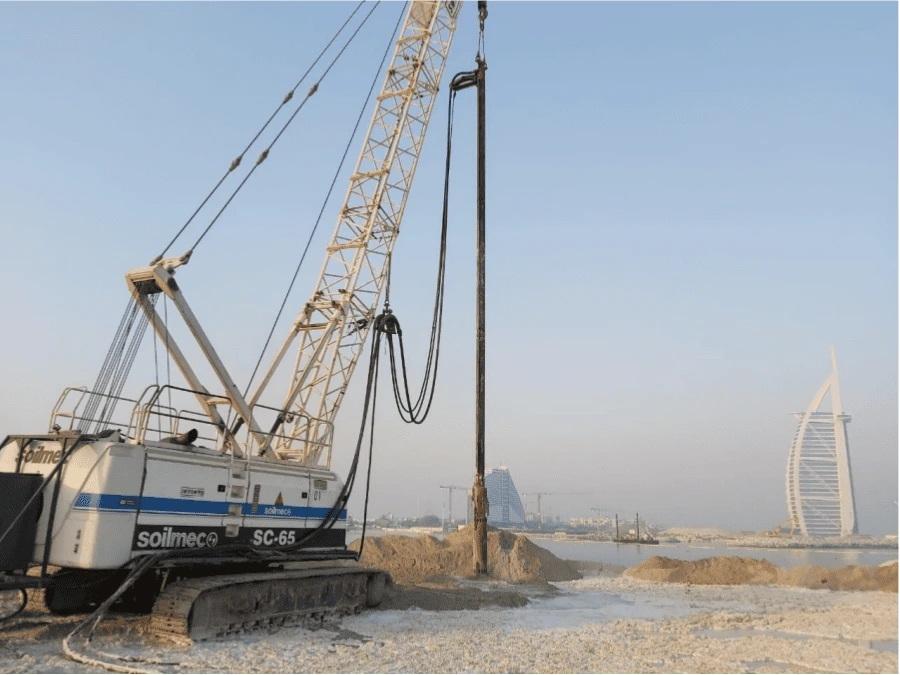
A vibroflot is a specialized ground improvement device that uses vibration to rearrange soil particles or assist in the installation of granular material columns. It typically consists of a vibrating probe driven by an electric motor or hydraulic system, depending on the equipment design.
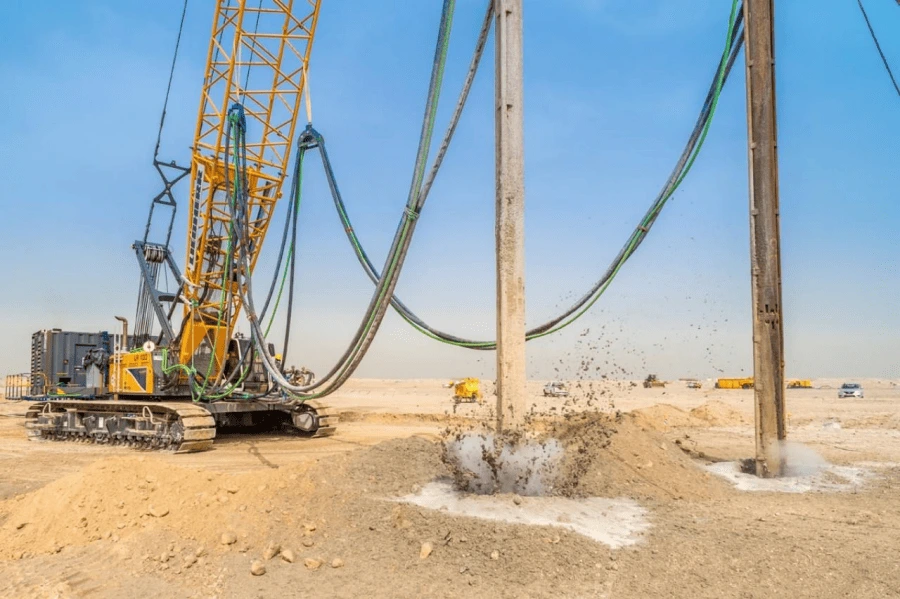
During operation, the vibroflot penetrates the ground to the required treatment depth. The vibration helps loosen and rearrange surrounding granular soil particles or facilitates the placement and compaction of stone or gravel.
The equipment is commonly used in two ground improvement applications:
Vibro Compaction
Vibro compaction densifies loose granular soil by rearranging its particles under vibration. Depending on soil conditions and the project design, the process can improve relative density and reduce the potential for settlement.
This method is most effective in soils with sufficient granular content and limited fines. High fines content can reduce the effectiveness of conventional vibro compaction.
Stone Column Construction
Stone column construction involves forming columns of compacted stone or gravel within the ground. These columns can reinforce the surrounding soil, improve composite ground performance, and provide drainage pathways.
Stone columns are commonly considered where the ground contains weaker soils that cannot be effectively treated through densification alone. Their effectiveness depends on soil properties, column geometry, installation technique, and the design requirements.
Main Applications of Vibroflot Equipment in the UAE
Reclaimed Land and Coastal Developments
Reclaimed land and coastal developments may contain loose granular fill or hydraulic fill that requires densification before construction.
Vibro compaction can be considered where the fill has suitable grading and fines content. The treatment aims to increase soil density and improve its engineering performance.
For these projects, contractors should evaluate the depth and composition of the fill, groundwater conditions, access for heavy equipment, and the potential impact of vibration on nearby structures.
Commercial and Residential Building Foundations
Large residential and commercial developments may require ground improvement to meet allowable settlement and bearing capacity criteria.
Depending on the subsurface conditions, vibroflot equipment can support either vibro compaction or stone column installation. The selected method should be based on geotechnical design rather than building type alone.
Ground improvement planning should also account for foundation loads, treatment coverage, neighboring structures, and verification testing.
Industrial Facilities and Warehouses
Industrial facilities and warehouses often require consistent ground performance across large floor areas. Differential settlement can affect floor slabs, storage systems, equipment foundations, and operational safety.
Vibro compaction may be suitable for loose granular deposits, while stone columns may be selected for certain weaker or more compressible soils.
The required treatment depth, column spacing, and improvement criteria should be established through geotechnical analysis and project-specific design.
Ports, Logistics Areas, and Infrastructure
Ports, logistics facilities, roads, and other infrastructure projects may involve large areas of fill and variable ground conditions.
Vibroflot-based ground improvement can be considered to increase soil density or reinforce selected soil profiles. Contractors should assess access requirements, working platform stability, groundwater, vibration limits, and construction productivity before choosing an installation system.
Top Feed vs. Bottom Feed Vibroflot Equipment
Two common vibroflot configurations used in stone column construction are top-feed and bottom-feed systems. Their main difference is how the stone or gravel reaches the installation point.
Top Feed Vibroflot
A top-feed system delivers stone from the ground surface into the treatment area around the vibroflot. The installation process may require a suitable method to maintain material supply and achieve the designed column dimensions.
Typical considerations:
- Suitable for projects where surface stone delivery can be organized efficiently.
- Requires coordination between aggregate supply, feeding, and compaction.
- Performance depends on the installation method and the soil’s ability to remain stable during construction.
Bottom Feed Vibroflot
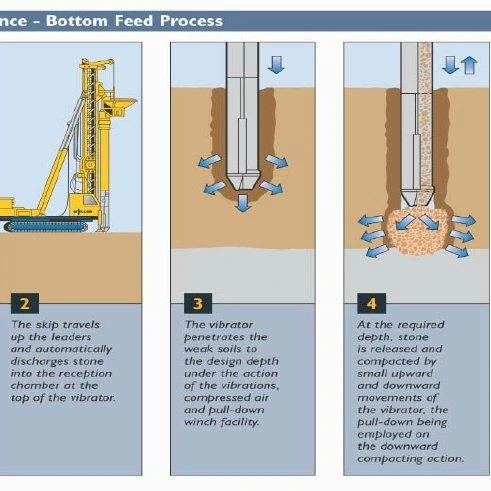
A bottom-feed system delivers stone through a feeding pipe toward the lower end of the vibroflot. This allows aggregate to be placed near the bottom of the developing column as the equipment is operated and withdrawn.
Typical considerations:
- Can support controlled aggregate delivery at depth.
- May be beneficial where maintaining a continuous stone supply is important.
- Requires a compatible feeding system and appropriate aggregate handling arrangements.
Which System Should Contractors Choose?
| Selection factor | Top feed | Bottom feed |
|---|---|---|
| Aggregate delivery | From the surface | Through a feeding pipe to depth |
| Material handling | Surface supply and feeding arrangements | Integrated or compatible bottom-feed supply |
| Main consideration | Surface feeding efficiency and soil stability | Feeding system compatibility and controlled placement |
| Final selection | Based on design and site conditions | Based on design and site conditions |
Neither system is universally better. Contractors should compare the proposed construction method, soil profile, aggregate specifications, equipment configuration, and project productivity requirements before making a decision.
Key Factors When Selecting Vibroflot Equipment
Choosing suitable vibroflot equipment requires more than comparing motor power or vibration force. The equipment must match the ground conditions and the required treatment method.
Soil Type and Fines Content
Soil grading is one of the most important factors in determining whether vibro compaction is appropriate.
Loose sands and other suitable granular soils may respond well to vibro compaction. Soils containing significant silt or clay may require stone columns or another ground improvement method.
A geotechnical investigation should establish the soil profile and identify the most appropriate treatment approach.
Treatment Depth
The required improvement depth influences vibroflot configuration, supporting equipment, lifting capacity, and construction procedures.
Contractors should confirm the designed treatment depth and evaluate whether the proposed system can achieve consistent results throughout the required soil profile.
Vibration Force and Operating Performance
Vibration force, frequency, amplitude, power requirements, and operating characteristics affect how the equipment performs in different soil conditions.
Equipment specifications should be assessed against the project’s geotechnical requirements. Higher power alone does not guarantee better ground improvement.
Water Supply and Aggregate Feeding
Water may be used during penetration and soil treatment in certain vibro compaction systems. Stone column installation requires a suitable method of supplying and placing aggregate.
The selected equipment should be compatible with the site’s water availability, aggregate grading, feeding arrangements, and construction sequence.
Compatibility With Supporting Equipment
A vibroflot installation system may require a crane, excavator, power pack, compressor, water supply system, feeding pipe, or other supporting equipment, depending on the configuration.
Before purchasing or renting a system, contractors should confirm lifting capacity, installation arrangement, power requirements, transport dimensions, and the availability of compatible accessories.
Quality Control and Verification
Ground improvement should be verified against the project’s design criteria. Depending on the method and ground conditions, verification may include penetration resistance testing, in-situ density assessment, load testing, or other specified geotechnical tests.
The equipment selection process should therefore consider not only installation productivity but also the ability to achieve and verify the required ground performance.
What Should UAE Contractors Confirm Before Purchasing or Renting Vibroflot Equipment?
Before selecting a vibroflot system for a UAE project, contractors should prepare a clear technical and commercial requirement list.
Key information includes:
- Project location and ground investigation report.
- Proposed treatment method: vibro compaction or stone columns.
- Required treatment depth and treatment area.
- Soil classification, fines content, and groundwater conditions.
- Required vibroflot configuration and power supply.
- Top-feed or bottom-feed requirements.
- Aggregate supply and handling arrangements, where applicable.
- Compatibility with available cranes and other supporting equipment.
- Target production rate and project schedule.
- Equipment availability, spare parts, technical support, and delivery arrangements.
For projects in Dubai, Abu Dhabi, Sharjah, and other UAE locations, local site access, transport logistics, working conditions, and project specifications should also be considered.
Purchasing or renting decisions should be based on the project’s duration, expected utilization, equipment availability, maintenance requirements, and total operating cost.
Vibroflot Equipment Supply for Ground Improvement Projects
For contractors and ground improvement specialists, selecting the right equipment is an important step toward efficient installation and reliable project results.
Rockway Equipment Trading LLC supplies construction machinery and equipment for foundation and infrastructure projects. Contractors evaluating vibroflot equipment can discuss their intended application, ground conditions, treatment depth, and required configuration to identify a suitable system.
When requesting an equipment quotation, provide the project location, required treatment method, expected operating depth, power requirements, and preferred delivery schedule. This information helps establish whether the proposed equipment is compatible with the project requirements.
Contact Rockway Equipment Trading LLC to discuss vibroflot equipment for ground improvement applications in the UAE.
Frequently Asked Questions
Vibroflot equipment is used for ground improvement, primarily for densifying suitable loose granular soils through vibro compaction and for assisting in the construction of stone columns.
No. Vibro compaction is generally most effective in suitable granular soils. Soils with high fines content or significant cohesive layers may require stone columns or alternative ground improvement methods. Site investigation and geotechnical assessment are essential.
Top-feed systems supply aggregate from the surface, while bottom-feed systems deliver aggregate through a feeding pipe toward the lower end of the installation tool. The preferred configuration depends on soil conditions, construction methods, and project requirements.
Consider soil type, treatment depth, required improvement method, vibration characteristics, power supply, aggregate feeding arrangements, supporting equipment, and verification requirements. The final selection should follow geotechnical and equipment compatibility assessments.
Provide the project location, intended application, soil investigation information, treatment depth, required system configuration, power supply details, supporting equipment availability, and expected delivery schedule.
It may be suitable for projects in Dubai, Abu Dhabi, and other UAE locations, depending on the subsurface conditions and ground improvement objectives. A site-specific assessment is needed to determine the appropriate method and equipment configuration.