
Choosing between double wall casing and single wall casing is an important decision in bored pile construction. The right casing system helps maintain borehole stability, control groundwater-related risks, and support the required construction method.
Both systems are used in foundation projects, but their designs, installation requirements, equipment compatibility, and costs can differ significantly. The most suitable option depends on ground conditions, pile dimensions, groundwater levels, installation equipment, and project specifications.
What Is Single Wall Casing?
Single wall casing is a steel tube with one structural wall. It is commonly used to support the upper section of a borehole or to provide temporary or permanent support where specified by the foundation design.
Depending on the construction method, single wall casing can be installed using a rotary drilling rig, casing oscillator, casing rotator, or other compatible equipment.
Single wall casing is widely used in bored piling because of its relatively straightforward construction and the availability of different diameters, lengths, wall thicknesses, and connection systems.
What Is Double Wall Casing?
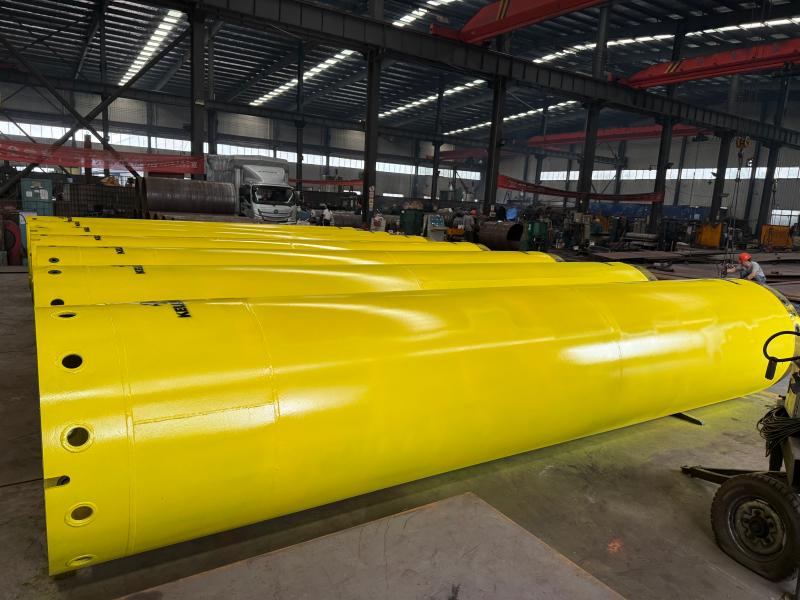
Double wall casing incorporates two concentric steel walls, typically an inner and an outer casing. The casing is typically manufactured from Q355B structural steel, offering good strength and weldability for foundation construction applications.
Double wall casing systems may be used in specialized foundation construction methods where the equipment and casing arrangement are designed to work together. Depending on the system, the configuration can support particular installation sequences, connection arrangements, or construction requirements.
Double Wall Casing vs. Single Wall Casing: Key Differences
The main differences relate to construction, equipment requirements, handling, and the intended piling method.
| Comparison Factor | Single Wall Casing | Double Wall Casing |
|---|---|---|
| Basic structure | One main steel wall | Two concentric steel walls |
| Overall configuration | Generally simpler | More complex, depending on the design |
| Weight and dimensions | Depend on diameter and wall thickness | May be heavier or larger due to the additional wall |
| Installation equipment | Compatible rotary rigs, casing oscillators, or rotators, as specified | Equipment must be compatible with the specific double wall arrangement |
| Connection design | Standard or project-specific casing joints | May require specialized casing joints, casing adaptors, or connections |
| Handling and storage | Usually simpler to inspect and stack | Requires consideration of both walls and the overall assembly |
| Maintenance | Inspection of wall condition, casing joints, and casing shoe | Inspection of both walls, casing joints, connections, and any system-specific components |
| Cost considerations | Depends on material, fabrication, and installation method | Depends on additional material, manufacturing complexity, equipment, and installation requirements |
| Applications | Building foundations, bridge piers, port structures, and urban bored piling requiring temporary or permanent borehole support. | Specialized foundation projects involving dedicated double-wall casing systems for building, bridge, and marine piling. |
Neither system is automatically stronger, faster, or more economical in every situation. Performance depends on the actual design, steel grade, wall thickness, joint strength, equipment, and site conditions.
Consider the Ground Conditions
Ground conditions are among the most important factors in casing selection.
Loose Sand and Gravel
Loose granular soils may be prone to collapse, particularly when groundwater is present or the borehole is left unsupported. Single wall casing can provide effective temporary support when correctly sized and installed.
A double wall casing system may also be appropriate where its configuration suits the selected construction method. The decision should be based on the system’s design and installation requirements, not simply on the assumption that two walls provide better borehole stability.
Soft Clay and Unstable Soil
Soft or sensitive soils can deform during excavation. Casing selection should account for soil strength, excavation depth, groundwater, and the sequence of drilling and casing installation.
The casing must be capable of resisting the loads expected during installation and removal. Contractors should also consider the risk of soil movement around the borehole and the effect of nearby structures.
Groundwater and Water-Bearing Strata
Groundwater can create additional challenges, including borehole instability, water inflow, and soil loss.
The selected casing system should be evaluated alongside the planned groundwater-control method, drilling procedure, and concrete placement sequence. Casing joints must meet the project’s requirements for fit and sealing; neither single wall nor double wall construction should automatically be assumed watertight.
Hard Layers and Mixed Ground
Hard soil layers, gravel deposits, and mixed ground can increase installation resistance and place additional loads on casing joints and casing shoes.
For these conditions, contractors should verify the casing’s structural capacity, joint torque rating, casing shoe design, and compatibility with the available installation equipment.
Match the Casing System to the Installation Method
The installation method determines how the casing is rotated, advanced, supported, and extracted.
Rotary Drilling with Temporary Casing
Single wall casing is commonly used with compatible rotary drilling equipment for temporary borehole support. The rig or casing system must provide sufficient torque and axial force for the required installation depth and ground conditions.
Full Casing Construction
In full casing construction, casing is advanced as excavation progresses to maintain borehole stability. Depending on the design and method, casing may be extracted during or after concrete placement, or retained permanently.
Single wall casing is used in many conventional full casing operations. Double wall casing may be suitable for specialized arrangements, but it is not a universal replacement for single wall casing.
Contractors should confirm the intended installation sequence and ensure that the casing, drilling rig, drive system, and concrete placement procedure work together.
Check Casing Diameter, Wall Thickness, and Structural Capacity
The casing must be designed for the loads encountered during installation, excavation, concrete placement, and extraction, where applicable.
Before choosing either system, confirm the following specifications:
- Casing diameter: Must correspond to the required pile diameter and construction tolerances.
- Wall thickness: Must provide adequate structural capacity for the anticipated loads.
- Steel grade: Must meet the project’s strength, toughness, and fabrication requirements.
- Joint design: Must safely transfer the required loads and torque between casing sections.
- Casing shoe: Must suit the ground conditions and the intended installation method.
- Casing length: Must accommodate the required support depth and the installation sequence.
- Connection compatibility: Must match the relevant casing driver, oscillator, rotator, or other installation equipment.
Double wall construction does not automatically mean that a casing is stronger than a single wall casing. Structural performance depends on the geometry, steel properties, connections, load transfer, and engineering design of the complete system.
Evaluate Equipment Compatibility
Casing selection must be coordinated with the available machinery.
For single wall casing, check the required rotary torque, casing connection dimensions, clamping arrangement, and compatibility with the rig or casing installation system.
For double wall casing, verify the complete assembly dimensions, how the inner and outer walls are connected or supported, and whether the installation equipment is designed to handle that configuration.
Before ordering, contractors should confirm:
- Equipment make and model.
- Maximum available torque and axial force.
- Casing diameter and connection specifications.
- Clamp, casing adaptor, and casing shoe compatibility.
- Total casing weight and lifting requirements.
- Required operating clearances and site access.
Compatibility should be confirmed using technical drawings and manufacturer specifications rather than relying on the casing type alone.
Compare Project Costs and Operating Efficiency
The lowest initial purchase price does not necessarily result in the lowest total project cost.
Single wall casing may offer a cost-effective solution where a conventional casing arrangement meets the technical requirements. Its relatively straightforward design can also simplify storage, transport, and inspection.
Double wall casing may involve additional material, fabrication, handling, or equipment considerations. These costs may be justified when the specific system provides a required construction benefit or meets a project-specific engineering requirement.
A useful cost comparison should include:
- Casing purchase or rental cost.
- Fabrication and connection costs.
- Transport and storage.
- Installation and extraction time.
- Equipment rental or operating costs.
- Maintenance, inspection, and repair.
- Expected reuse and service life.
Compare the complete construction process under the same site conditions. Do not assume that double wall casing will always reduce installation time or that single wall casing will always be cheaper over its service life.
How to Choose the Right Casing for Your Bored Pile Project
The following decision process can help narrow down the appropriate casing system.
Choose Single Wall Casing When:
- A conventional casing arrangement meets the project’s engineering requirements.
- The planned installation equipment is designed for single wall casing.
- The required borehole support can be achieved with the selected diameter and wall thickness.
- Transport, handling, and repeated use favor a straightforward casing configuration.
- No specific requirement justifies a more specialized system.
Consider Double Wall Casing When:
- The project specification calls for a particular double wall arrangement.
- The intended installation method is designed around that casing configuration.
- Compatible equipment, connections, and handling arrangements are available.
- The system offers a defined engineering or operational benefit for the project.
- The complete assembly has been verified for the expected loads and site conditions.
Selecting Casing for Reliable Bored Pile Construction
Selecting between double wall casing and single wall casing requires more than comparing the number of steel walls. Contractors should consider the complete casing design, ground conditions, installation method, equipment compatibility, and total project cost.
Single wall casing is a practical option for many conventional bored pile applications. Double wall casing should be considered where its specific configuration meets a defined construction or engineering requirement.
For reliable results, confirm the casing specifications and installation procedure with the project engineer and equipment supplier before procurement or mobilization.
Frequently Asked Questions
Single wall casing has one main steel wall, while double wall casing incorporates two concentric walls. Their suitability depends on the system design, installation method, structural requirements, and equipment compatibility.
Not necessarily. Strength depends on the steel grade, wall thickness, geometry, connections, and loading conditions. The complete casing assembly must be evaluated against the expected installation and service loads.
Yes. Single wall casing is commonly used in full casing bored pile construction when the casing dimensions, structural capacity, installation equipment, and construction sequence meet the project requirements.
Both systems may be suitable, depending on the ground conditions and construction method. The casing must provide the required borehole support, and the installation procedure must account for groundwater, soil collapse risk, and the loads acting on the casing.
The main information includes pile diameter, casing dimensions, ground conditions, groundwater level, required support depth, installation equipment, joint design, and whether the casing will be temporary or permanent.