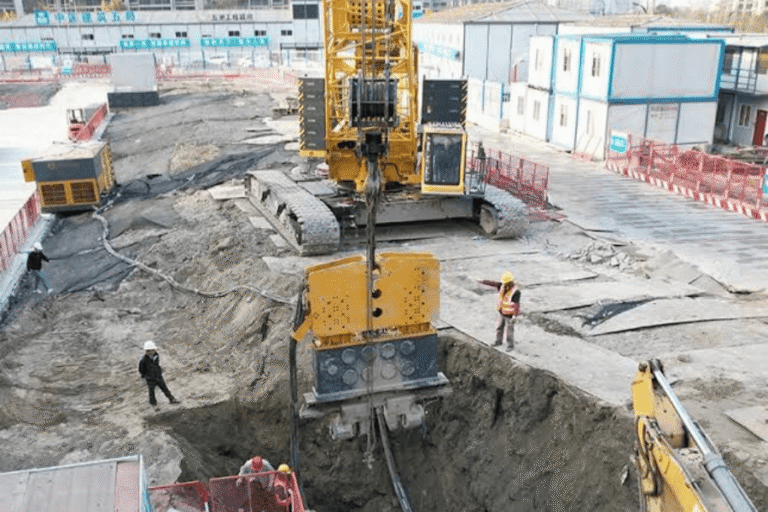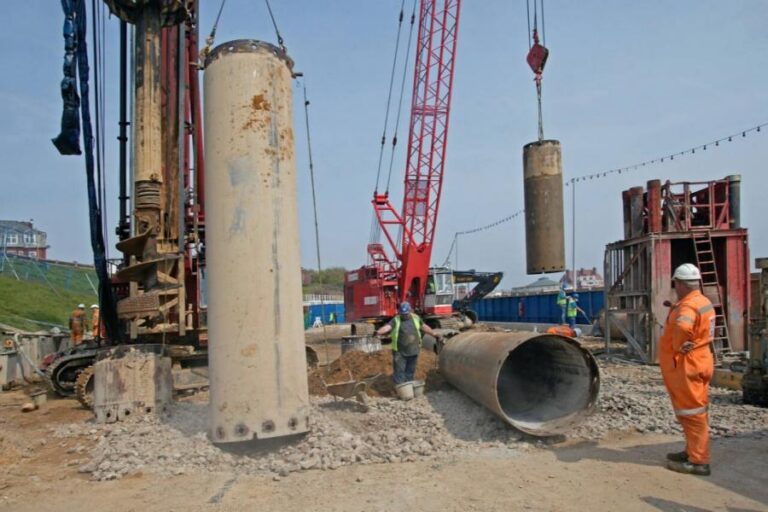

Selecting the right drilling bucket is an important part of rotary foundation drilling. The bucket is not simply a container for excavated material; it is a cutting tool that must transfer the drilling rig’s torque and crowd force into the formation while collecting and retaining spoil.
A bucket that performs efficiently in clay or sand may not be suitable for gravel, weathered rock, or hard formations. For this reason, professional selection should consider the ground conditions, bucket geometry, cutting teeth, drilling rig, Kelly Bar, pile diameter, drilling depth, and expected wear as one complete system.
For piling contractors, the goal is not necessarily to choose the heaviest or most aggressive bucket. The objective is to select a configuration that provides sufficient cutting performance without creating unnecessary resistance, wear, or loading on the drilling rig.
Start with the Ground Conditions
The ground investigation report should be the starting point for drilling bucket selection. Formation strength, abrasiveness, particle size, groundwater, and changes between geological layers can all influence bucket performance.
A project may contain several different formations over the drilling depth, so one bucket configuration may not always be appropriate for the entire borehole.
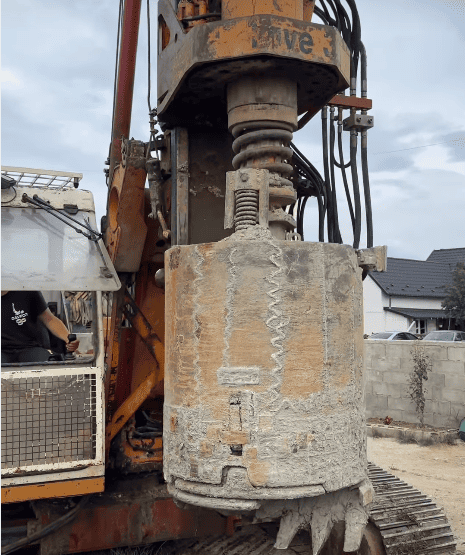
Soil and Clay
Soft to medium cohesive soils generally require a bucket with efficient penetration and good spoil retention.
The cutting edge and teeth should enter the formation without requiring excessive crowd force. The internal geometry should also allow excavated material to enter the bucket and remain inside during lifting.
For clay, excessive material adhesion can become an issue. Bucket geometry and discharge design therefore become important, particularly when the material has a high moisture content.
Typical cutting systems: soil teeth or flat teeth, depending on the formation and bucket design.
Sand and Loose Ground
Sand and loose granular materials require good spoil retention. If the bucket does not retain the material effectively, part of the load may fall back into the borehole during lifting.
For these conditions, contractors should consider:
- Cutting-edge geometry
- Bucket capacity
- Bottom-opening configuration
- Material retention
- Discharge efficiency
- Groundwater conditions
Flat cutting teeth can be suitable for many soft-ground applications, but the actual tooth configuration should be selected according to the material characteristics.
Gravel and Cobbles
Gravel introduces more impact and abrasion than ordinary soil. Large cobbles can also produce localized impact loads on individual teeth.
A stronger cutting structure and more wear-resistant teeth may therefore be required. Tooth spacing should allow the cutting system to engage the formation without becoming excessively obstructed by larger particles.
Typical cutting systems: heavy-duty flat teeth or bullet teeth, depending on particle size, strength, and the amount of rock present.
Weathered Rock
Weathered rock is particularly important because its drilling characteristics can vary considerably. A formation described simply as “weathered rock” may contain relatively weak material in one section and much harder rock or boulders in another.
In these conditions, contractors should consider:
- Rock strength
- Abrasiveness
- Fracturing
- Presence of gravel or cobbles
- Degree of weathering
- Expected impact loading
Bullet teeth are often considered where a more concentrated cutting action is required.
Hard Rock
Hard rock requires a more specialized drilling system. A conventional soil bucket may not provide sufficient penetration and can experience rapid tooth wear.
Depending on the rock strength and drilling method, contractors may use heavy-duty bullet teeth, rock drilling buckets, core barrels, or roller-bit-based tools.
A drilling bucket should not automatically be regarded as the solution for every hard-rock condition. When the formation becomes too strong or abrasive for efficient tooth cutting, the drilling method may need to change.
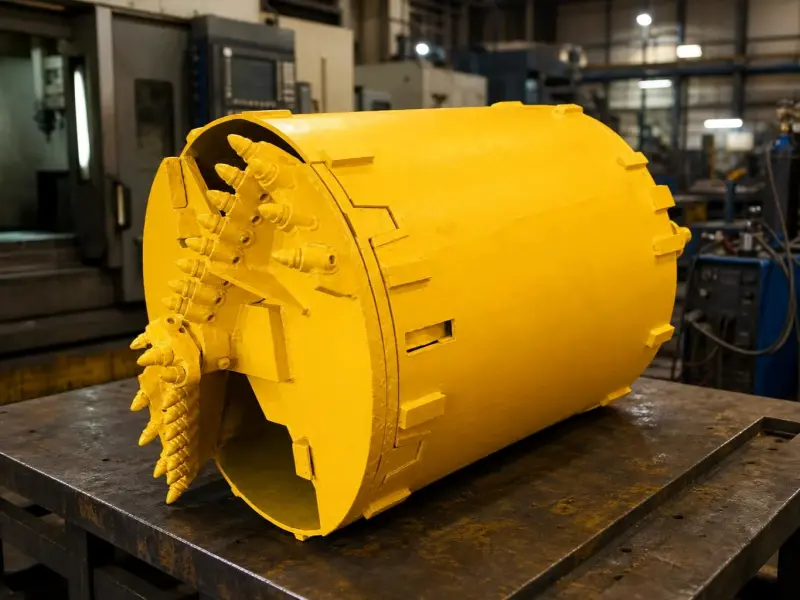
Understand the Main Drilling Bucket Parameters
Drilling buckets are manufactured in a wide range of dimensions. The actual specification depends on the drilling rig, pile diameter, ground conditions, bucket design, and manufacturer.
Common parameters include:
| Parameter | Typical Consideration |
|---|---|
| Cutting Diameter | Commonly selected to match the required borehole diameter |
| Bucket Height | Often around 800–1,200 mm for many conventional rotary buckets, depending on diameter and design |
| Shell Thickness | Commonly around 16–25 mm in representative bucket designs |
| Bottom Plate Thickness | Often approximately 40–50 mm, depending on bucket size and duty |
| Teeth Quantity | Varies with bucket diameter, cutting pattern, and tooth type |
| Bucket Weight | Can range from several hundred kilograms to several tonnes |
| Connection | Must match the Kelly adapter and drilling rig |
| Bucket Capacity | Depends on internal diameter, height, and bottom configuration |
These figures should be regarded as typical engineering ranges rather than universal standards. Published manufacturer specifications show, for example, drilling buckets from approximately 600 mm to 2,500 mm diameter, with shell thicknesses around 16–25 mm and bottom components commonly around 40–50 mm thick.
As bucket diameter increases, the number of cutting teeth and overall tool weight generally increase as well. Representative manufacturer tables show buckets from 600 mm to 1,500 mm with weights from roughly 650 kg to more than 2,000 kg, while larger 2,000–2,500 mm buckets can weigh several tonnes.
The final specification should always be calculated according to the actual bucket design rather than applying these numbers as fixed industry standards.
Bucket Diameter Is Not the Only Dimension
The bucket diameter normally corresponds to the required pile or borehole diameter, but diameter alone does not determine whether a bucket is suitable.
A contractor should also check:
- Bucket height
- Shell thickness
- Bottom plate thickness
- Cutting-edge thickness
- Tooth quantity
- Tooth arrangement
- Bucket weight
- Internal volume
- Connection dimensions
- Opening and discharge mechanism
For example, two 1,500 mm buckets may have the same cutting diameter but significantly different weights, tooth layouts, bottom structures, and applications.
This is why “1,500 mm drilling bucket” is not a complete technical specification.
Select the Right Drilling Bucket Design
Drilling buckets can be configured differently according to the material being excavated and the required discharge method.
Soil Drilling Buckets
Soil buckets are generally designed for efficient excavation in relatively soft formations such as clay, silt, sand, and mixed soils.
The cutting system prioritizes penetration and spoil collection rather than maximum impact resistance.
Rock Drilling Buckets
Rock buckets use a more robust cutting structure and are commonly fitted with bullet teeth or other rock-cutting elements.
They are intended for formations where ordinary soil teeth would experience excessive wear or insufficient penetration.
Single-Cut and Double-Cut Configurations
Single-cut and double-cut designs refer to different cutting arrangements and bottom configurations.
The appropriate configuration depends on the ground conditions, cutting pattern, spoil removal requirements, and manufacturer’s design.
Bottom-Opening System
Many rotary drilling buckets use a mechanical or hydraulic/mechanical bottom-opening mechanism to discharge excavated material.
The opening system should be reliable because repeated opening and closing cycles place mechanical loads on the locking and hinge components.
Choose the Right Drilling Bucket Teeth
The cutting teeth are one of the most critical parts of the bucket.
The tooth must withstand the combination of compression, impact, abrasion, and repeated loading generated during drilling.
Selecting teeth only by model number or appearance is not sufficient. The tooth must also match its holder and the bucket’s cutting pattern.
Bullet Teeth
Bullet teeth use a concentrated cutting point to penetrate and fracture harder material. They are widely used on drilling tools for mixed ground, gravel, weathered rock, and selected rock formations.
Examples of bullet teeth models used in foundation drilling include:
- C31HD
- B47K17.5H
- B47K19H
- B47K22H
The models should not be treated as a universal hardness classification because naming conventions and recommended applications can vary between manufacturers.
For example, the B47K22H is a heavy-duty bullet tooth configuration intended for demanding drilling conditions. It may be considered where higher resistance to impact and wear is required, subject to the actual bucket, holder, and formation.
The B47K19H and B47K17.5H can similarly be considered for different duty levels within compatible cutting systems.
The correct choice should always be verified against the manufacturer’s technical data and holder compatibility.
Flat Teeth
Flat teeth have a broader cutting profile and are commonly used for soil and relatively soft formations.
One example is BFZ80, which can be used in compatible drilling bucket systems where a wider cutting edge is preferred.
Flat teeth are generally suitable where the formation can be cut or sheared efficiently without requiring the concentrated point attack of a heavy bullet tooth.
Typical applications may include:
- Clay
- Silt
- Sand
- Soft fill
- Selected mixed soils
However, flat teeth should not be selected solely because the formation is classified as “soil.” Dense gravel, cemented layers, or weathered rock may require a different cutting system.
Match Tooth Type to Ground Conditions
A practical selection approach is:
| Ground Condition | Typical Tooth Direction | Examples |
|---|---|---|
| Clay / Silt | Flat or soil teeth | BFZ80 and compatible soil teeth |
| Sand | Flat / soil cutting system | BFZ-series or equivalent |
| Gravel | Heavy-duty cutting system | Bullet or reinforced teeth |
| Mixed Ground | Bullet / combination cutting system | C31HD, B47K17.5H |
| Weathered Rock | Heavy-duty bullet teeth | B47K19H or equivalent |
| Harder Rock | Heavy-duty rock cutting system | B47K22H or specialized rock tool |
| Very Hard Rock | Consider alternative drilling tool | Core barrel / roller-bit system |
This table is a selection framework rather than a fixed hardness chart. Rock strength, abrasiveness, jointing, quartz content, moisture, and impact conditions can significantly change tooth performance.
For example, a highly abrasive formation can cause rapid wear even when its compressive strength is not exceptionally high.
Match the Bucket to the Rotary Drilling Rig
A drilling bucket must be compatible with the drilling rig’s available torque, crowd force, Kelly Bar, and lifting capacity.
The basic relationship is:
Rotary Drive → Kelly Bar → Kelly Adapter → Drilling Bucket → Formation
The drilling rig must provide sufficient torque to rotate the cutting system and sufficient crowd force to maintain penetration.
Before selecting the bucket, contractors should check:
- Rig manufacturer and model
- Maximum rotary torque
- Available crowd force
- Kelly Bar configuration
- Kelly adapter
- Maximum allowable tool weight
- Required drilling diameter
- Maximum drilling depth
A bucket that is technically suitable for the formation may still be unsuitable for the rig if its weight, connection, or required drilling force exceeds the machine’s operating capability.
Check the Kelly Bar and Bucket Connection
The Kelly Bar is the mechanical link between the rotary drive and the drilling tool.
The bucket connection therefore needs to match the Kelly adapter and Kelly Bar configuration.
Important dimensions include:
- Kelly box or adapter size
- Connection pin dimensions
- Locking arrangement
- Bucket connection geometry
- Overall tool length
For example, a bucket intended for a Bauer-type connection should not be assumed to fit another rig simply because the bucket diameter is identical.
For friction Kelly Bars, interlocking Kelly Bars, and combined Kelly Bar configurations, the connection should be specified according to the actual drilling rig and adapter.
Consider Drilling Depth and Bucket Capacity
Deep drilling introduces additional considerations.
Every drilling cycle involves:
Penetration → Filling → Lifting → Discharge → Re-entry
As the drilling depth increases, cycle time becomes increasingly important. The contractor therefore needs to balance bucket capacity with tool weight and spoil-handling efficiency.
A larger bucket may collect more material per cycle, but it also increases:
- Tool weight
- Lifting load
- Rotary resistance
- Required crowd force
- Potential handling difficulty
For deep foundation work, the most productive bucket is not necessarily the largest one. The optimum configuration is the one that provides an appropriate balance between cutting performance, filling efficiency, tool weight, and cycle time.
Consider Bucket Weight and Structural Strength
Bucket weight is an important parameter when matching the tool to the rig.
Representative commercial drilling bucket specifications show that a 600–1,000 mm bucket may weigh roughly 650–1,400 kg, while 1,500–1,800 mm configurations can exceed 2,000–3,000 kg depending on construction and tooth configuration. Larger 2,000–2,500 mm buckets can reach several tonnes.
These are examples rather than fixed standards.
The actual weight depends on:
- Shell thickness
- Bottom plate design
- Connection
- Tooth type
- Reinforcement
- Opening mechanism
- Wear protection
Structural strength is particularly important when the bucket is exposed to repeated impact from gravel, cobbles, or rock.
Wear Protection and Maintenance
A drilling bucket is exposed to continuous mechanical loading, so wear should be monitored throughout the project.
Key inspection areas include:
Cutting Teeth
Check for:
- Tip wear
- Carbide damage
- Missing teeth
- Uneven wear
- Tooth rotation or abnormal movement
Tooth Holders
Inspect for:
- Cracking
- Deformation
- Excessive clearance
- Weld damage
Cutting Edge
Look for:
- Excessive thinning
- Deformation
- Cracks
- Uneven wear
Bucket Shell
Inspect the shell and reinforcement areas for:
- Abrasion
- Cracks
- Local deformation
- Weld failure
Uneven tooth wear can be an important indicator. It may suggest an unsuitable cutting pattern, uneven loading, incorrect tooth orientation, or abnormal interaction between the bucket and formation.
Practical Drilling Bucket Selection Checklist
Before ordering a drilling bucket, piling contractors should confirm the following:
| Factor | Information Required |
|---|---|
| Project | Pile type and drilling method |
| Pile Diameter | Required borehole diameter |
| Ground | Soil, clay, sand, gravel, weathered rock, hard rock |
| Formation Strength | Available geotechnical data where applicable |
| Abrasiveness | Quartz content / abrasive characteristics where available |
| Rig Model | Manufacturer and model |
| Rotary Torque | Available operating torque |
| Crowd Force | Available crowd force |
| Kelly Bar | Type, diameter, length, and section configuration |
| Connection | Kelly adapter and bucket connection |
| Bucket Diameter | Required cutting diameter |
| Bucket Height | Required working configuration |
| Bucket Weight | Compatibility with rig capacity |
| Bucket Capacity | Required spoil volume per cycle |
| Tooth Type | Flat, soil, bullet, or rock cutting system |
| Tooth Model | Example: BFZ80, C31HD, B47K19H, B47K22H |
| Holder | Must match the selected tooth |
| Drilling Depth | Maximum required borehole depth |
| Wear Conditions | Expected impact and abrasion |
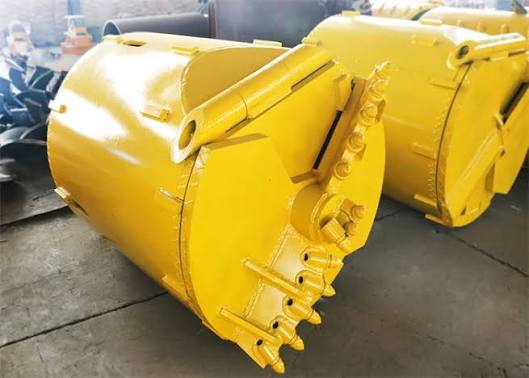
How Piling Contractors Can Make the Final Selection
A practical selection process can be reduced to seven steps:
Step 1 — Confirm the pile diameter
Determine the required borehole diameter and project tolerance.
Step 2 — Review the ground investigation
Identify the soil and rock layers, including changes with depth.
Step 3 — Identify the most demanding layer
Do not select the bucket solely according to the upper soil layer if hard rock is present deeper in the borehole.
Step 4 — Match the tooth system
Choose flat, soil, bullet, or other cutting elements according to the formation.
Step 5 — Confirm the holder and connection
Make sure the tooth fits the holder and the bucket fits the Kelly adapter.
Step 6 — Check the rig capacity
Verify torque, crowd force, lifting capacity, Kelly Bar configuration, and tool weight.
Step 7 — Confirm the complete specification
Check diameter, height, capacity, weight, tooth configuration, connection, and working depth before manufacturing or purchase.
Final Considerations
Drilling bucket selection should be based on the complete drilling system, not bucket diameter alone. Contractors should consider:
- Ground conditions: soil, clay, sand, gravel, weathered rock, or hard rock
- Bucket: diameter, height, capacity, weight, and cutting structure
- Cutting teeth: type, model, holder, and wear resistance
- Drilling rig: torque, crowd force, and lifting capacity
- Kelly Bar: type, length, and connection
- Drilling depth: required working depth and drilling conditions
A properly matched bucket and cutting system can improve penetration, spoil removal, tool life, and overall drilling efficiency. For changing geological conditions, different bucket or drilling-tool configurations may be required to maintain consistent performance.
Frequently Asked Questions(FAQ)
Select a drilling bucket based on the formation, pile diameter, drilling depth, rig capacity, Kelly Bar connection, and required cutting system.
Hard rock generally requires a heavy-duty rock drilling bucket with suitable bullet teeth or other specialized cutting tools. For very hard formations, a core barrel or roller-bit tool may be more appropriate.
Tooth type, geometry, carbide properties, and cutting arrangement directly affect penetration, wear resistance, spoil removal, and drilling efficiency.
Check the rig’s rotary torque, crowd force, lifting capacity, Kelly Bar type, Kelly adapter, bucket diameter, and tool weight before selecting the bucket.
Common parameters include bucket diameter, height, capacity, weight, shell thickness, bottom thickness, tooth type, tooth quantity, connection dimensions, and working depth.