
A Kelly Bar is one of the key torque-transmission components of a rotary drilling rig. Although Kelly Bars may look similar from the outside, their specifications can vary significantly depending on the drilling rig, required depth, torque level, ground conditions, and drilling tools.
For contractors and equipment buyers, understanding the main Kelly Bar specifications is important when replacing an existing bar, ordering a new one, or matching a Kelly Bar with a rotary drilling rig.
This guide explains the key specifications, including section configuration, diameter, length, Kelly box, connection dimensions, and other parameters that should be checked before purchase.
What Are the Main Kelly Bar Specifications?
A Kelly Bar specification normally includes several dimensions and technical parameters rather than a single size.
The main specifications include:
- Number of telescopic sections
- Kelly Bar outer diameter
- Section length
- Overall retracted length
- Overall extended length
- Kelly box dimensions
- Kelly stub or adapter dimensions
- Key and guide configuration
- Wall thickness
- Material and heat treatment
- Maximum applicable drilling depth
- Compatible drilling rig
- Friction or interlocking configuration
These parameters need to work together. A Kelly Bar with the correct diameter but an unsuitable connection or insufficient length may still be incompatible with the drilling rig.
Kelly Bar Section Configuration
Kelly Bars are manufactured as telescopic assemblies consisting of multiple sections.
Common configurations include:
- 2-section Kelly Bar
- 3-section Kelly Bar
- 4-section Kelly Bar
- 5-section Kelly Bar
- 6-section Kelly Bar
Some specialized configurations may use more sections depending on the required drilling depth and rig design.
Each section slides inside or outside the adjacent section while maintaining torque transmission and axial movement.
Why Does the Number of Sections Matter?
The section configuration affects the relationship between:
Retracted Length → Extended Length → Available Drilling Depth
For example, a multi-section Kelly Bar can achieve a considerable working length while maintaining a relatively compact transportation and storage length.
However, adding sections does not automatically mean the drilling rig can achieve a greater effective drilling depth. The actual drilling depth also depends on:
- Rig mast height
- Kelly Bar length
- Drilling tool height
- Pile diameter
- Borehole conditions
- Kelly Bar working stroke
- Drilling method
Therefore, the Kelly Bar should be specified according to the complete rig and tooling configuration.
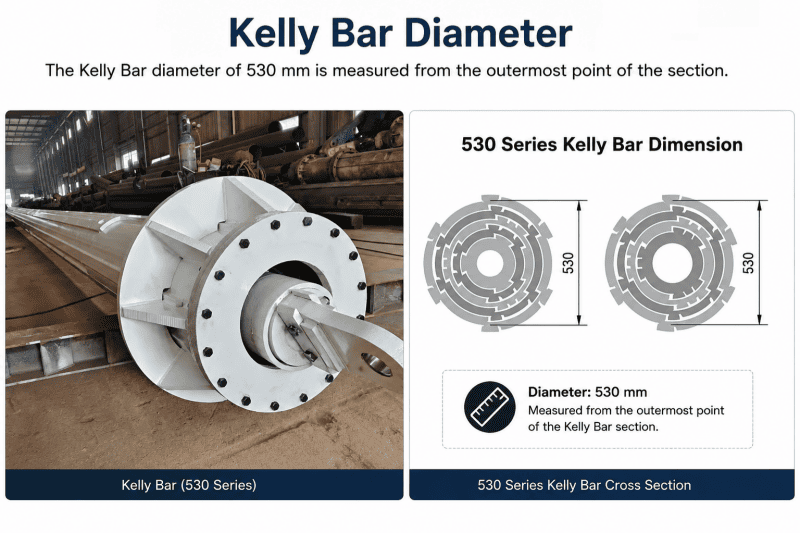
Kelly Bar Diameter
Diameter is one of the most visible Kelly Bar dimensions, but it should not be considered independently.
The outer diameter of the Kelly Bar must provide sufficient structural strength while remaining compatible with the rotary drilling rig and Kelly guide system.
For foundation drilling applications, Kelly Bars are commonly available in different diameter ranges depending on the rig class. Representative configurations may range from approximately 300 mm to more than 600 mm, while larger custom designs can be manufactured for heavy-duty drilling rigs.
Typical diameter selection depends on:
- Rotary drilling rig model
- Rotary torque
- Kelly box dimensions
- Required drilling depth
- Drilling tool diameter
- Section configuration
- Structural loading
A larger Kelly Bar is not necessarily better. The diameter should be matched to the rig’s original design and the required drilling performance.
Kelly Bar Length
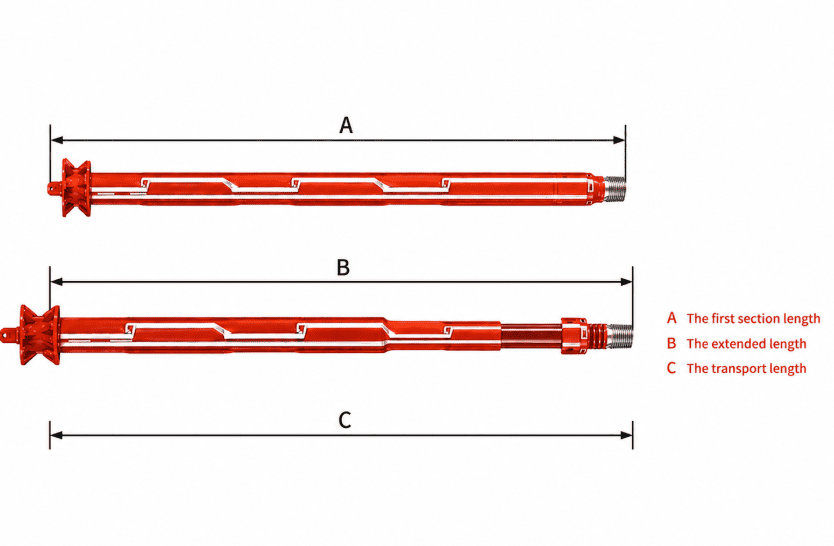
Kelly Bar length normally needs to be considered in two conditions:
Retracted Length
The retracted length is the overall length when the telescopic sections are nested.
It is important for:
- Transportation
- Rig installation
- Storage
- Mast clearance
- Handling
Extended Length
The extended length represents the maximum telescopic working length of the Kelly Bar.
It directly influences the potential drilling depth but should not be considered equal to the final pile depth.
The actual drilling depth depends on the relationship between the Kelly Bar, drilling tool, rig mast, and operating stroke.
A simplified configuration can be represented as:
Kelly Bar Length + Drilling Tool Length + Rig Working Stroke → Available Drilling Range
The exact calculation depends on the rotary drilling rig and Kelly Bar design.
Kelly Box and Kelly Stub Dimensions
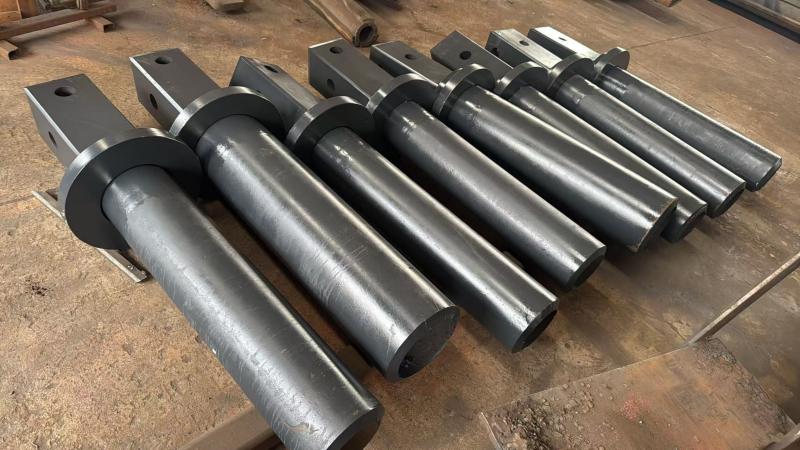
The Kelly Box is the connection between the rotary drive and the Kelly Bar.
Its dimensions are critical when replacing a Kelly Bar because the box must correspond to the rotary drive and rig configuration.
Common dimensions that may need to be confirmed include:
- Kelly box width
- Kelly box height
- Stub dimensions
- Pin-hole dimensions
- Connection length
- Key arrangement
For example, some Kelly Bar specifications may use Kelly stub dimensions such as:
- 130 × 130 mm
- 150 × 150 mm
- 200 × 200 mm
These are examples of commonly specified dimensions and should not be treated as universal standards.
The correct dimensions must be confirmed against the actual drilling rig and existing Kelly Bar.
Kelly Bar Key and Guide Configuration
The telescopic sections require a mechanism to transmit torque while allowing the sections to extend and retract.
Depending on the Kelly Bar configuration, this may involve drive keys, locking keys, guide strips, wear plates, or other transmission components.
The key system is particularly important because it transfers substantial torque between telescopic sections.
During inspection, contractors should check:
- Key wear
- Contact surfaces
- Deformation
- Cracks
- Excessive clearance
- Lubrication condition
- Uneven wear between sections
Excessive wear in the key system can affect torque transmission and increase movement between sections.
Wall Thickness and Structural Strength
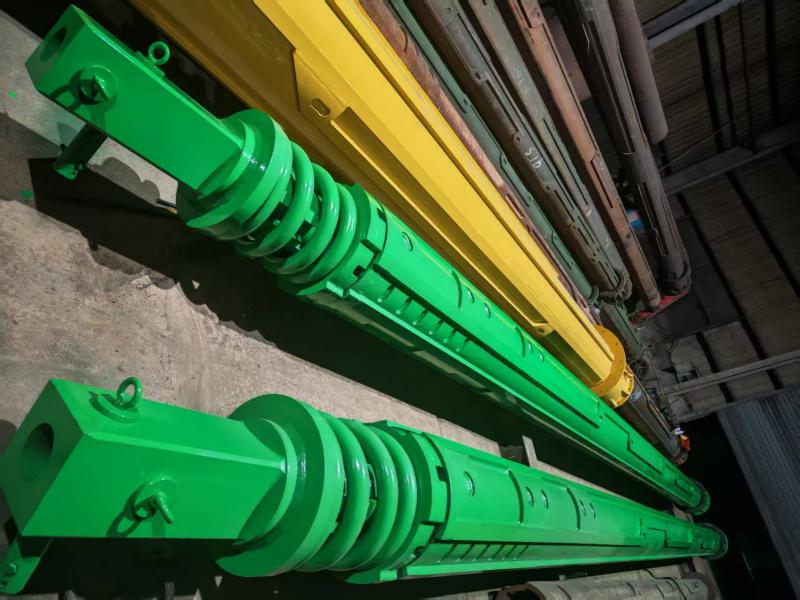
Kelly Bar sections are manufactured from high-strength steel tubing or specially produced structural components.
Wall thickness is an important specification because the sections must withstand:
- Torsional loading
- Axial compression
- Bending loads
- Repeated impact
- Vibration
- Fatigue during telescopic operation
However, simply increasing wall thickness is not always the correct solution.
The final design must balance strength, weight, stiffness, telescopic clearance, and manufacturing requirements.
Representative Kelly Bar designs may use different wall thicknesses depending on the section diameter and duty class. Therefore, wall thickness should be specified according to the engineering design rather than selected independently.
Kelly Bar Materials
Material selection has a direct effect on the Kelly Bar’s strength, toughness, wear resistance, and fatigue performance.
Common materials used in Kelly Bar manufacturing may include:
- Q355B
- 27SiMn
- 35CrMo
- Other high-strength alloy steels
The material selection depends on the section design and required mechanical properties.
Heat treatment is also important. Proper heat treatment can improve the strength and wear resistance of critical components while maintaining sufficient toughness for repeated drilling loads.
For heavy-duty applications, the material grade should be evaluated together with:
- Yield strength
- Tensile strength
- Toughness
- Hardness
- Heat-treatment process
- Welding requirements
- Fatigue performance
How Kelly Bar Specifications Relate to Drilling Depth
Kelly Bar length is closely related to drilling depth, but the two values are not identical.
For a deep foundation project, the contractor should consider the complete drilling arrangement:
Rig Mast → Rotary Drive → Kelly Bar → Kelly Adapter → Drilling Tool → Borehole
The required Kelly Bar length depends on:
- Required pile depth
- Rig mast height
- Drilling tool dimensions
- Kelly Bar configuration
- Soil and rock conditions
- Required operating stroke
A longer Kelly Bar can provide greater working reach, but it may also increase transportation requirements, weight, and handling considerations.
For this reason, Kelly Bar length should be calculated according to the actual rig and project requirements.
Connection to Drilling Tools
The lower end of the Kelly Bar connects to the drilling tool through a Kelly adapter or tool connection.
The connection must be compatible with the selected:
- Drilling bucket
- Auger
- Core barrel
The connection transfers both rotational torque and axial force.
Before ordering a Kelly Bar, contractors should therefore confirm the dimensions of the existing drilling tools and adapters rather than selecting the Kelly Bar based only on the rig model.
Kelly Bar Specifications and Rig Compatibility
The drilling rig is one of the most important references when selecting a Kelly Bar.
A proper specification should normally include:
| Specification | What to Confirm |
|---|---|
| Rig Model | Manufacturer and exact model |
| Kelly Bar Type | Friction, interlocking,Full-Locking |
| Sections | Number of telescopic sections |
| Diameter | Section outer diameter |
| Length | Retracted and extended length |
| Kelly Box | Dimensions and connection |
| Kelly Stub | Size and configuration |
| Key System | Key dimensions and arrangement |
| Material | Steel grade |
| Heat Treatment | Required treatment and hardness |
| Tool Connection | Adapter and drilling-tool compatibility |
| Working Depth | Required drilling depth |
| Rig Torque | Maximum/working torque |
| Crowd Force | Available crowd force |
Providing these details can significantly reduce the risk of ordering an incorrectly configured Kelly Bar.
How to Read a Kelly Bar Specification
A Kelly Bar specification can be understood by separating it into four main groups:
Structural Specifications
- Diameter
- Wall thickness
- Section length
- Number of sections
- Overall length
- Weight
Connection Specifications
- Kelly box
- Kelly stub
- Adapter
- Pin dimensions
- Tool connection
Performance Specifications
- Applicable drilling depth
- Torque capacity
- Crowd force
- Rig compatibility
Manufacturing Specifications
- Material grade
- Heat treatment
- Key material
- Wear protection
- Welding and inspection requirements
This approach makes it easier to compare different Kelly Bar configurations without focusing on only one dimension.
What Information Should Be Provided When Ordering a Kelly Bar?
When requesting a quotation or replacement Kelly Bar, contractors should provide as much information as possible.
A useful technical inquiry should include:
1. Drilling Rig Model
For example, the exact manufacturer and model of the rotary drilling rig.
2. Required Drilling Depth
Specify the required maximum pile depth.
3. Kelly Bar Type
Friction, interlocking, or combined configuration.
4. Number of Sections
For example, 3-section, 4-section, or 5-section.
5. Existing Kelly Bar Dimensions
Provide diameter, length, Kelly box, and connection dimensions where available.
6. Drilling Tools
Specify the drilling bucket, auger, core barrel, or other tools to be used.
7. Ground Conditions
Provide basic information about the soil and rock formations.
This information allows the Kelly Bar to be configured according to the actual drilling application rather than using a generic specification.
Final Considerations
Kelly Bar specifications involve much more than diameter and length. Section configuration, connection dimensions, key design, material, working length, drilling depth, and rig compatibility all need to be considered together.
For contractors, the safest approach is to start with the drilling rig and required drilling depth, then determine the appropriate section configuration, diameter, connection, and tool interface.
A correctly specified Kelly Bar should provide reliable torque transmission, sufficient structural strength, and compatibility with the drilling rig and tools throughout the intended drilling operation.
Frequently Asked Questions(FAQ)
The main Kelly Bar specifications include the number of sections, outer diameter, section length, retracted and extended length, Kelly box, Kelly stub, key configuration, wall thickness, material, heat treatment, drilling depth, and rig compatibility.
Kelly Bar diameter should be matched to the rotary drilling rig, Kelly drive system, required torque, drilling depth, section configuration, and drilling tool dimensions. The largest available diameter is not necessarily the most suitable option.
Kelly Bar length directly affects the available working range, but it does not equal the final drilling depth. Actual depth depends on the Kelly Bar, rig mast, rotary drive position, drilling tool length, working stroke, and drilling conditions.
Ideally, provide the exact drilling rig model, Kelly Bar type, number of sections, required drilling depth, diameter, retracted and extended length, Kelly box and stub dimensions, drilling tool connection, working torque, and crowd force.
Friction Kelly Bars transmit torque through friction between telescopic sections, while interlocking Kelly Bars use mechanical locking between the sections to transmit higher torque and provide positive engagement. The appropriate type depends on the drilling rig, ground conditions, required torque, and drilling depth.