
Tremie pipe concrete placement is a critical operation in bored pile construction, particularly when the borehole contains groundwater or drilling slurry. Even when the correct tremie pipe system has been selected, problems during concrete placement can affect pile integrity, construction efficiency, and project costs.
Common issues include tremie pipe blockage, concrete segregation, slurry contamination, loss of pipe embedment, interrupted concrete flow, and excessive pipe movement. These problems are often related to concrete workability, operating procedures, equipment condition, or poor coordination between drilling and concreting operations.
Understanding the causes of these problems allows contractors to identify risks early and take corrective action before they affect the completed pile.
Why Tremie Pipe Problems Occur During Concrete Placement
Tremie concrete placement requires several operations to work together:
- Concrete production
- Concrete transportation
- Concrete pumping
- Tremie pipe handling
- Borehole preparation
- Slurry management
- Reinforcement cage installation
- Continuous monitoring
A problem in one part of the process can affect the entire operation.
For example, delayed concrete delivery can interrupt the flow inside the tremie pipe. Low concrete workability can increase the risk of blockage, while incorrect pipe movement can allow slurry to enter the pipe.
For this reason, troubleshooting should consider the entire concrete placement process rather than the tremie pipe alone.
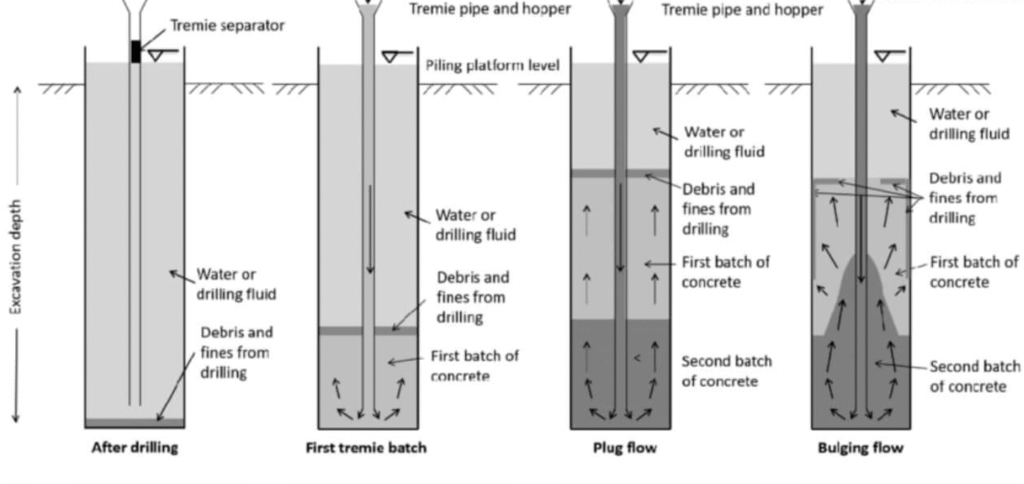
Tremie Pipe Blockage
Tremie pipe blockage is one of the most disruptive problems during concrete placement. When concrete cannot pass through the pipe smoothly, the placement process may slow down or stop completely.
Common Causes
Tremie pipe blockage can be caused by:
- Concrete with insufficient workability
- Excessive waiting time before placement
- Concrete segregation
- Hardened concrete remaining inside the pipe
- Oversized aggregate
- Poorly cleaned pipe sections
- Incorrect hopper feeding
- Sudden interruption of concrete supply
The risk can increase when concrete remains inside the pipe for an extended period.
Practical Solutions
Before concrete placement:
- Inspect the internal passage of every pipe section.
- Remove hardened concrete and foreign material.
- Confirm the concrete mix is suitable for tremie placement.
- Prepare sufficient concrete supply before starting.
During placement:
- Maintain a consistent concrete supply.
- Avoid unnecessary interruptions.
- Monitor concrete flow continuously.
- Stop and investigate if abnormal resistance occurs.
A clean pipe and stable concrete supply are important for reducing blockage risk.
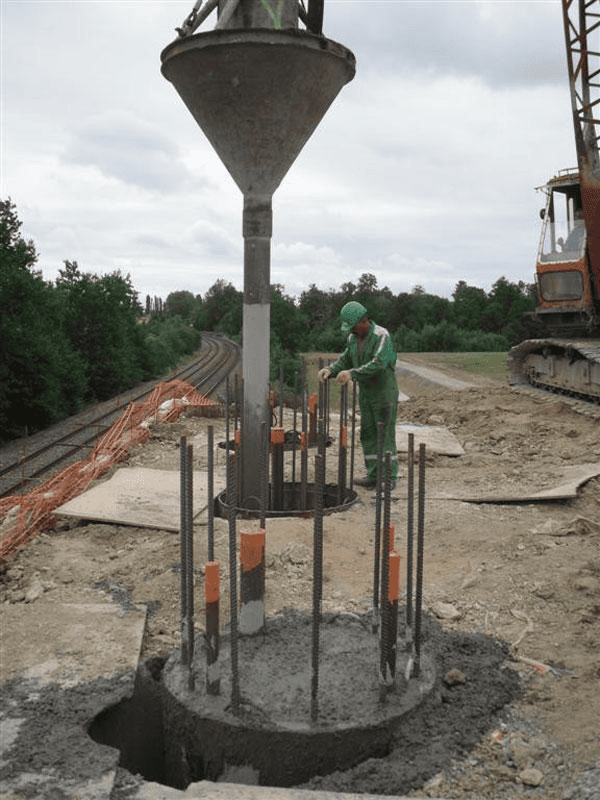
Concrete Segregation Inside the Tremie System
Concrete segregation occurs when coarse aggregate, cement paste, and other components separate rather than remaining uniformly distributed.
This can reduce concrete quality and make flow through the tremie pipe less predictable.
Potential Causes
Segregation may result from:
- Improper concrete mix design
- Excessive free fall
- Inconsistent concrete batches
- Excessive vibration or handling
- Poor feeding into the tremie system
- Excessive interruption during placement
How to Reduce Segregation
Contractors should coordinate with the concrete supplier to maintain consistent mix properties throughout the pour.
The tremie system should also be operated in a controlled manner to minimize unnecessary disturbance of the concrete.
Continuous placement is particularly important because repeated interruptions can increase the risk of inconsistent concrete conditions inside the pile.
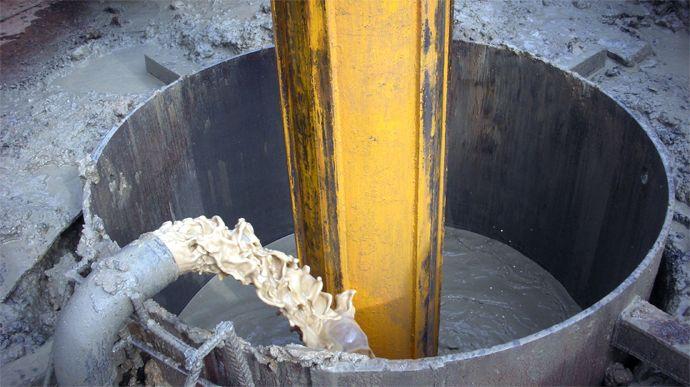
Slurry or Water Contamination
Slurry contamination is a major concern when placing concrete into a borehole containing drilling fluid.
Fresh concrete must displace slurry progressively from the bottom of the pile upward. If slurry enters the tremie pipe or becomes excessively mixed with concrete, the quality of the pile can be affected.
Why Does Contamination Happen?
Common causes include:
- Incorrect initial pipe positioning
- Insufficient concrete embedment
- Excessive pipe lifting
- Unstable concrete level
- Poor slurry control
- Inadequate borehole cleaning
How to Reduce Contamination
Before concrete placement, contractors should verify the borehole condition and slurry properties.
During placement:
- Position the tremie outlet correctly.
- Maintain sufficient embedment in fresh concrete.
- Avoid lifting the pipe too quickly.
- Monitor the concrete level continuously.
- Track the actual concrete volume placed.
The goal is to maintain a controlled separation between fresh concrete and the slurry being displaced.
Loss of Tremie Pipe Embedment
Maintaining the correct embedment of the tremie outlet in fresh concrete is one of the most important operating requirements.
If the pipe is lifted too far, the outlet may become exposed to slurry or water. This can allow contaminated material to enter the pipe and disrupt the concrete column.
Possible Causes
Loss of embedment may occur because of:
- Incorrect estimation of concrete level
- Excessive pipe lifting
- Delayed measurement
- Poor coordination between crane and concrete operators
- Unexpected changes in concrete volume
Prevention
Operators should continuously monitor:
- Concrete volume delivered
- Estimated concrete level
- Tremie pipe depth
- Amount of pipe removed
- Actual pile depth
Pipe removal should be controlled according to the concrete level rather than simply following a predetermined lifting schedule.
Interrupted Concrete Flow
Tremie concrete placement is generally planned as a continuous operation. Interruptions can create additional risks inside the pipe and borehole.
Common Reasons for Interruption
Concrete flow may stop because of:
- Concrete truck delays
- Pump failure
- Tremie pipe blockage
- Insufficient concrete supply
- Equipment breakdown
- Poor site coordination
Why Continuous Supply Matters
If concrete flow stops for too long, concrete inside the tremie pipe can become less workable. This may increase the risk of blockage when placement resumes.
Long interruptions can also complicate control of the concrete level and pipe embedment.
Practical Prevention Measures
Before starting the pour, contractors should confirm:
- Concrete delivery schedule
- Number of available mixer trucks
- Pump condition
- Backup equipment
- Communication between operators
- Required concrete volume
For large piles, concrete supply planning is especially important because the total volume can be substantial.
Excessive Tremie Pipe Movement
Tremie pipes should be handled carefully during concrete placement.
Excessive vertical movement can disturb the concrete or affect the position of the pipe outlet. Unnecessary movement may also complicate control of the pipe embedment.
Common Causes
- Incorrect lifting operation
- Poor communication between crane operator and concrete crew
- Rapid removal of pipe sections
- Inaccurate concrete level estimation
Recommended Practice
Pipe sections should be removed progressively and in a controlled sequence.
Operators should coordinate pipe movement with actual concrete placement conditions instead of lifting the assembly according to a fixed timetable.
Concrete Flow Is Too Slow
Slow concrete flow does not always indicate a tremie pipe defect.
It can be related to the combined effect of:
- Concrete workability
- Pipe internal diameter
- Aggregate size
- Pump pressure
- Pipe length
- Pipe cleanliness
- Concrete delivery rate
If the flow becomes noticeably slower than expected, operators should first determine whether the problem originates from the concrete, pumping system, or tremie pipe.
Troubleshooting Sequence
A practical inspection sequence is:
Check concrete → Check pump → Check hopper → Check pipe → Check borehole conditions
This helps prevent unnecessary pipe replacement when the actual cause is related to concrete supply or pumping.
Hopper Feeding Problems
The hopper provides the entry point for concrete into the tremie system. Poor feeding can interrupt the continuous flow of concrete.
Potential problems include:
- Hopper capacity too small for the required delivery rate
- Irregular concrete feeding
- Concrete accumulation around the hopper
- Inadequate connection between pump and hopper
- Foreign material entering the system
The hopper should be inspected before each placement operation and kept free from hardened concrete and debris.
Tremie Pipe Joint Problems
The pipe connections are repeatedly assembled and removed during foundation work. Damaged or poorly maintained joints can create operational problems.
Potential issues include:
- Damaged threads
- Deformed flanges
- Worn seals
- Misalignment
- Excessive joint wear
- Concrete residue on connection surfaces
Before Installation
Inspect each connection and make sure:
- Threads are clean
- Flanges are not deformed
- Sealing components are in good condition
- Coupling surfaces are free of concrete
- Pipe sections align correctly
A reliable joint system reduces the chance of leakage, misalignment, and difficult disassembly.
Tremie Pipe Wear and Deformation
Repeated use can gradually affect the condition of tremie pipe sections.
Wear is more likely when pipes are:
- Frequently lifted and lowered
- Exposed to abrasive materials
- Poorly cleaned
- Dragged across the ground
- Stored without proper support
Inspection Points
Check for:
- Pipe bending
- Wall deformation
- Cracks
- Weld damage
- Connection wear
- Corrosion
- Concrete buildup
Damaged sections should be repaired or replaced before being returned to service.
Problems Caused by Poor Borehole Preparation
Not every tremie concrete problem originates from the tremie system.
Borehole conditions can have a major influence on concrete placement.
Potential issues include:
- Excessive sediment at the pile base
- Unstable borehole walls
- Poor slurry properties
- Excessive groundwater
- Inadequate cleaning before concreting
Before installing the tremie system, contractors should verify that the borehole meets the project’s requirements.
Proper drilling, cleaning, slurry management, and reinforcement installation create better conditions for subsequent concrete placement.
Concrete Volume Does Not Match the Theoretical Pile Volume
Another useful warning sign is a significant difference between theoretical and actual concrete consumption.
The theoretical volume can be estimated from the designed pile dimensions, while actual consumption depends on the real borehole geometry and ground conditions.
If concrete consumption is unexpectedly high or low, contractors should investigate:
- Actual borehole diameter
- Borehole enlargement
- Ground collapse
- Concrete level measurements
- Concrete delivery records
- Pipe operation
Tracking concrete volume throughout the pour can provide useful information about actual pile conditions.
A Practical Tremie Pipe Troubleshooting Table
| Problem | Possible Cause | Recommended Check |
|---|---|---|
| Pipe blockage | Low workability or hardened concrete | Check concrete and pipe interior |
| Slow concrete flow | Pump, mix, or pipe resistance | Check concrete, pump, and pipe |
| Slurry contamination | Insufficient pipe embedment | Check concrete level and pipe depth |
| Concrete segregation | Mix or placement problem | Check concrete consistency and operation |
| Interrupted flow | Delivery or equipment failure | Check concrete supply and pump |
| Difficult pipe removal | Hardened concrete or damaged joint | Inspect pipe and connections |
| Excessive pipe movement | Poor lifting control | Coordinate crane and concrete crew |
| Unexpected concrete volume | Borehole enlargement or measurement issue | Compare theoretical and actual volume |
| Joint leakage | Damaged connection or seal | Inspect coupling surfaces |
| Pipe deformation | Impact or excessive handling | Inspect pipe body and storage |
How to Prepare Before a Tremie Concrete Pour
Many tremie pipe problems can be prevented before concrete placement starts.
1. Inspect the Pipe System
Check:
- Pipe sections
- Connections
- Hopper
- Lifting cap
- Base pipe
- Sealing components
2. Clean the Pipe
Remove hardened concrete, soil, and foreign material from previous operations.
3. Confirm Borehole Conditions
Check:
- Borehole depth
- Bottom sediment
- Slurry condition
- Groundwater
- Reinforcement cage position
4. Confirm Concrete Supply
Ensure that the concrete delivery schedule can support continuous placement.
5. Prepare Lifting Equipment
The crane or lifting system should be ready to install, adjust, and remove tremie pipe sections safely.
6. Establish Communication
The concrete pump operator, crane operator, drilling crew, and site supervisor should coordinate the placement sequence before work begins.
When Should a Tremie Pipe Be Replaced?
Tremie pipes do not necessarily need to be replaced simply because they have been used on multiple projects.
Replacement or repair should be considered when inspection identifies:
- Significant wall deformation
- Cracked welds
- Severe corrosion
- Damaged threads
- Deformed flanges
- Worn coupling components
- Persistent leakage
- Internal obstruction that cannot be adequately cleaned
Regular inspection can help distinguish normal wear from damage that may affect safe operation.
How Proper Tremie Pipe Management Improves Project Efficiency
Tremie pipe performance depends on more than the pipe itself.
Efficient concrete placement requires coordination between:
Borehole preparation → tremie installation → concrete supply → pipe operation → concrete level monitoring → pipe removal
A well-maintained tremie system combined with consistent concrete supply and controlled operation can help reduce:
- Unplanned downtime
- Concrete waste
- Pipe blockage
- Rework
- Equipment damage
- Construction delays
For large foundation projects, these improvements can have a direct impact on overall project cost and schedule.
Final Takeaway
Most tremie pipe problems during bored pile construction are preventable when contractors control the complete concrete placement process.
The most important areas to monitor are:
- Concrete workability
- Continuous concrete supply
- Pipe cleanliness
- Borehole condition
- Tremie pipe embedment
- Pipe movement
- Joint condition
- Concrete volume
- Equipment coordination
When a problem occurs, identifying its source before taking corrective action is important. A slow concrete flow, for example, may be caused by the concrete mix or pump rather than the tremie pipe itself.
For contractors working on bored pile and deep foundation projects, regular inspection, proper preparation, and controlled operation can significantly improve tremie concrete placement reliability.
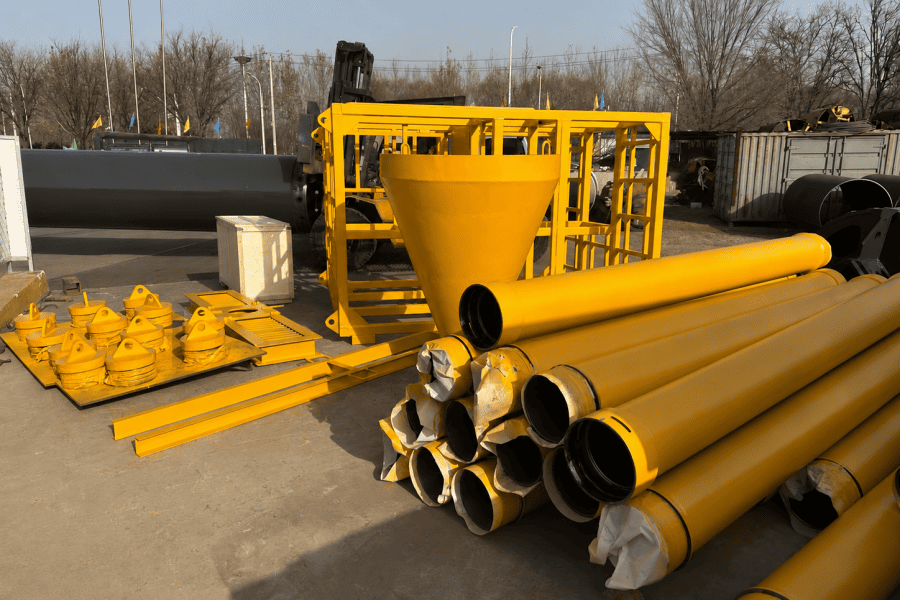
Rockway supplies tremie pipe systems and related piling accessories for foundation drilling and bored pile construction. Tremie pipe components can be configured according to project requirements, including pipe sections, hopper, lifting cap, base pipe, and connection components.
Frequently Asked Questions(FAQ)
Pipe blockage and interrupted concrete flow are common operational problems. They can be associated with low concrete workability, hardened concrete inside the pipe, inconsistent concrete supply, or inadequate pipe cleaning.
Possible causes include low concrete workability, segregation, hardened concrete, excessive aggregate size, pump problems, or an obstruction inside the pipe. The concrete, pumping system, hopper, and pipe should all be checked.
If the tremie outlet rises out of fresh concrete, slurry or water may enter the pipe and contaminate the concrete. Operators should carefully monitor concrete level and pipe depth throughout placement.
Keep the pipe clean, use concrete with suitable workability, maintain a consistent concrete supply, minimize unnecessary interruptions, and inspect the pipe before installation.
Some types of wear or connection damage may be repairable, depending on the severity and location. Severely deformed, cracked, or structurally compromised sections should be removed from service and replaced.