Selecting the correct hydraulic pile breaker is not simply a matter of matching the pile diameter. Factors such as pile shape, concrete strength, reinforcement layout, pile head height, hydraulic power supply, and project productivity all influence the final equipment selection.
Many contractors focus only on the pile diameter when purchasing a pile breaker. However, using an undersized or oversized machine can reduce breaking efficiency, increase equipment wear, and even damage reinforcement or the remaining pile structure.
This guide explains how professional foundation contractors choose hydraulic pile breakers for different bored pile diameters, with practical engineering examples and selection parameters.
Why Correct Pile Breaker Selection Matters
Hydraulic pile breakers operate by generating radial compressive force around the pile head. To achieve a clean and uniform fracture, every hydraulic cylinder must apply nearly identical pressure.
If the breaker is incorrectly matched:
- Uneven cracking may occur.
- Concrete may break below the cut-off level.
- Reinforcement cages can deform.
- Hydraulic cylinders experience uneven loading.
- Productivity decreases significantly.
Proper equipment selection ensures:
- Accurate pile cut-off elevation
- Minimal reinforcement damage
- Higher daily production
- Longer equipment service life
- Lower operating costs
Key Parameters Before Selecting a Hydraulic Pile Breaker
Professional contractors normally evaluate six factors before choosing equipment.
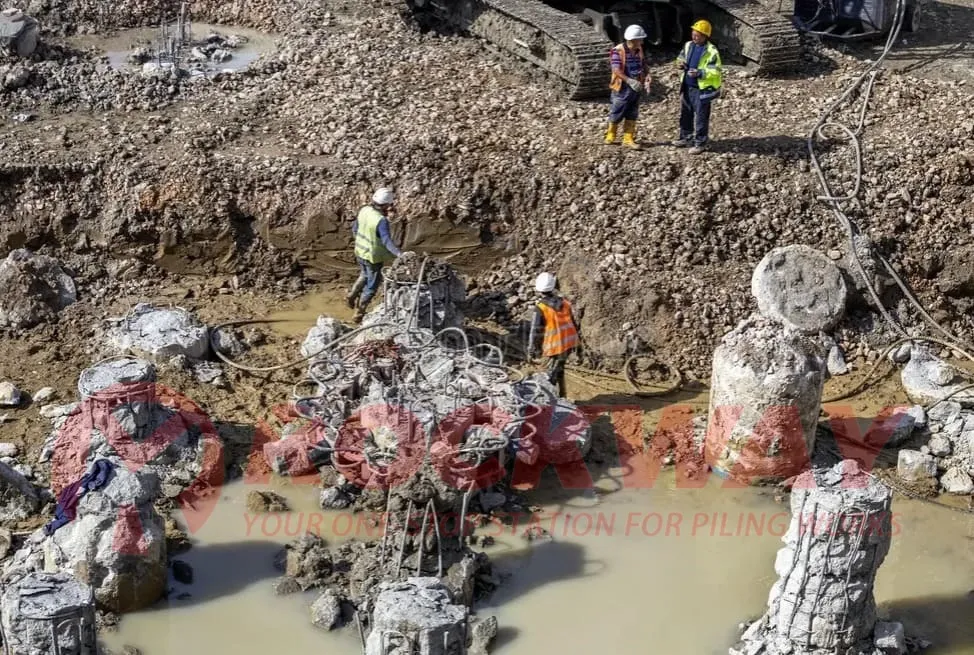
1. Pile Diameter
Pile diameter determines the number of hydraulic modules required.
Typical bored pile diameters include:
| Pile Diameter | Typical Application |
|---|---|
| 600 mm | Residential buildings |
| 800 mm | Commercial buildings |
| 1000 mm | High-rise structures |
| 1200 mm | Bridge foundations |
| 1500 mm | Metro projects |
| 1800–2000 mm | Offshore and heavy infrastructure |
Each increase in diameter requires additional hydraulic modules to maintain uniform pressure around the pile.
2. Concrete Strength
Concrete grade has a direct impact on the required breaking force.
| Concrete Grade | Breaking Difficulty |
|---|---|
| C25 | Low |
| C30 | Low |
| C35 | Medium |
| C40 | Medium-High |
| C50 | High |
| C60+ | Very High |
Projects using C50 or higher concrete often require higher hydraulic pressure and longer breaking cycles.
3. Reinforcement Density
Closely spaced reinforcement increases resistance during pile breaking.
Typical reinforcement includes:
- 12–20 longitudinal bars
- Ø20–Ø40 mm rebars
- Spiral reinforcement at 150–250 mm spacing
Higher reinforcement density requires more uniform hydraulic loading rather than simply increasing force.
4. Pile Head Height
Recommended pile head allowance:
- 300–500 mm for building foundations
- 500–800 mm for bridge piles
- Up to 1000 mm for marine foundations
Greater pile head height may require multiple breaking cycles.
5. Hydraulic Power Source
Most hydraulic pile breakers are powered by:
- Excavators
- Hydraulic power packs
- Stationary hydraulic stations
Typical hydraulic requirements include:
| Parameter | Typical Range |
|---|---|
| Operating Pressure | 28–35 MPa |
| Hydraulic Flow | 60–180 L/min |
| Oil Temperature | Below 65°C |
Insufficient flow significantly reduces breaking speed.
6. Daily Production Target
Equipment selection should also consider project output.
Example:
| Project Size | Daily Piles |
|---|---|
| Small | 10–20 |
| Medium | 20–40 |
| Large | 40–80 |
| Mega Project | 80+ |
Higher production targets often justify larger hydraulic stations and additional module sets.
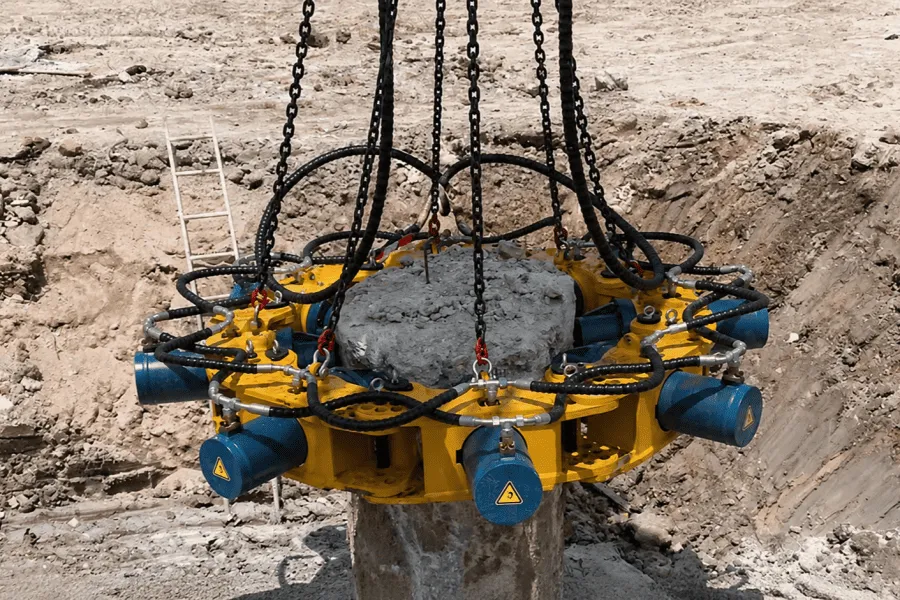
Recommended Pile Breaker Configurations by Pile Diameter
The following table illustrates typical selection guidelines.
| Pile Diameter | Typical Modules | Hydraulic Pressure | Excavator Size |
|---|---|---|---|
| 600 mm | 6–7 | 28–30 MPa | 18–22 t |
| 800 mm | 7–8 | 30 MPa | 20–25 t |
| 1000 mm | 8–9 | 30–32 MPa | 22–30 t |
| 1200 mm | 9–10 | 32 MPa | 25–35 t |
| 1500 mm | 10–12 | 32–35 MPa | 30–40 t |
| 1800–2000 mm | 12–14 | 35 MPa | 40–50 t |
Note: Actual module quantity depends on the manufacturer’s module width and cylinder arrangement.
Matching Hydraulic Flow and Pressure
Many contractors assume that higher pressure always results in faster breaking. In practice, hydraulic flow is equally important because it determines cylinder movement speed.
A balanced hydraulic system should provide:
- Stable pressure
- Continuous oil flow
- Minimal pressure fluctuations
- Fast cylinder synchronization
For example:
| Hydraulic Flow | Typical Performance |
|---|---|
| 60 L/min | Small piles |
| 90 L/min | Medium piles |
| 120 L/min | Large piles |
| 160–180 L/min | Continuous heavy-duty operation |
Hydraulic systems with inadequate flow often cause inconsistent cracking and longer cycle times.
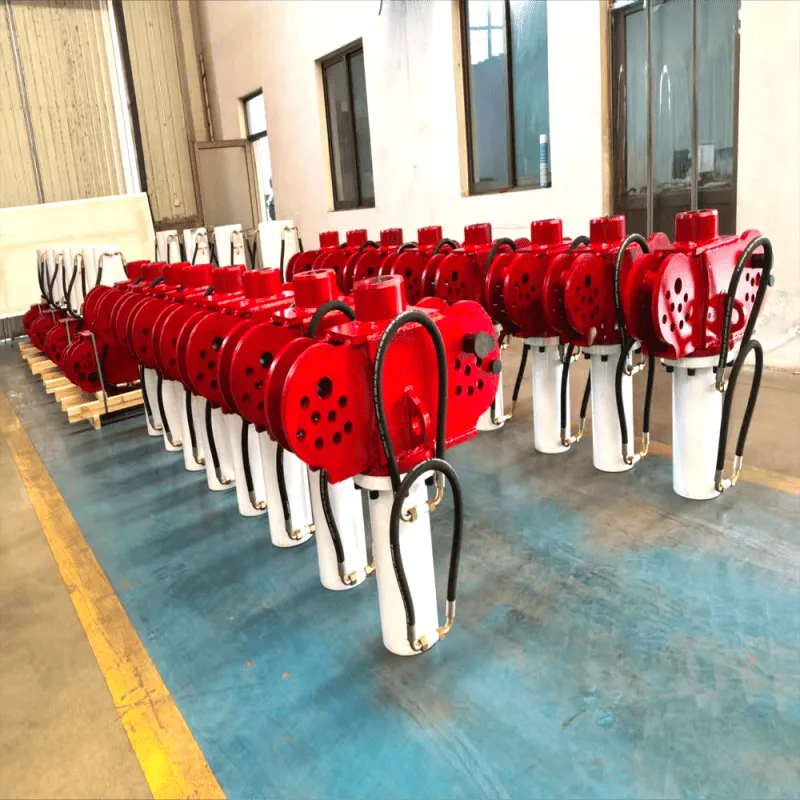
Selecting Module Quantity for Different Diameters
Modular hydraulic pile breakers allow contractors to add or remove breaking modules based on pile diameter.
Example:
| Diameter | Module Quantity |
|---|---|
| 600 mm | 6 |
| 800 mm | 7 |
| 1000 mm | 8 |
| 1200 mm | 9 |
| 1500 mm | 11 |
Increasing module quantity ensures that the force remains evenly distributed around the circumference, reducing localized stress concentrations.
For contractors handling multiple pile sizes on one project, a modular system offers greater flexibility than a fixed-size breaker.
Choosing the Right Pile Breaker for Different Ground Conditions
Ground conditions influence the stability of the pile during breaking.
Soft Clay
- Lower vibration requirements
- Standard hydraulic pressure is generally sufficient
- Care should be taken to prevent pile movement.
Dense Sand and Gravel
- Higher lateral resistance
- Stable support during breaking
- Moderate to high hydraulic pressure recommended.
Hard Rock Socketed Piles
- Usually constructed with higher-strength concrete (C40–C60)
- Require greater breaking force
- Longer operating cycles may be necessary.
Marine Foundations
- Larger pile diameters
- High reinforcement ratios
- Corrosion-resistant hydraulic components recommended
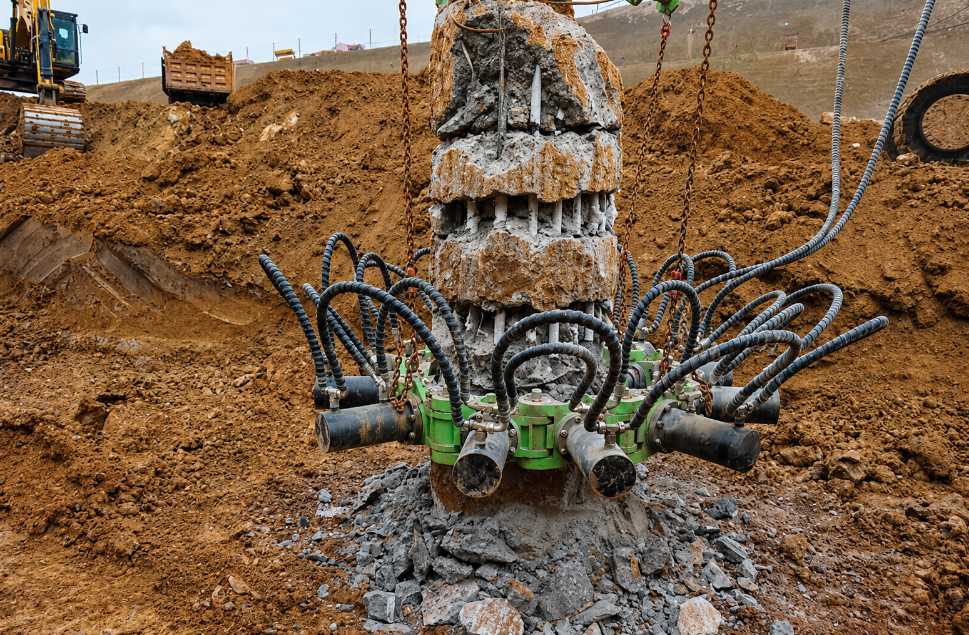
Case Study 1: High-Rise Building Foundation
Project: 38-story office tower
Location: Southeast Asia
Project Parameters
- 186 bored piles
- Diameter: 800 mm
- Concrete grade: C35
- Reinforcement: 16 × Ø25 mm
- Pile head allowance: 450 mm
Equipment Selection
- Modular hydraulic pile breaker
- 8 hydraulic cylinders
- Operating pressure: 30 MPa
- Hydraulic flow: 90 L/min
- Powered by a 22-ton excavator
Results
- Average breaking time: 6–8 minutes per pile
- Reinforcement exposure achieved without cutting bars
- Daily productivity: approximately 55 piles
- No measurable damage to the remaining pile shaft during post-breaking inspection
Case Study 2: Highway Bridge Project
Project: River crossing bridge foundation
Project Parameters
- 96 bored piles
- Diameter: 1500 mm
- Concrete grade: C50
- Reinforcement cage: 28 × Ø32 mm
- Cut-off allowance: 700 mm
Equipment Selection
- 12-module hydraulic pile breaker
- Operating pressure: 35 MPa
- Hydraulic flow: 160 L/min
- Powered by a 38-ton excavator with an auxiliary hydraulic circuit
Results
- Average cycle time: 12–15 minutes per pile
- Uniform circumferential fracture around the pile head
- Approximately 65% reduction in labor requirements compared with pneumatic jackhammer breaking
- Consistent pile head quality reduced follow-up trimming work
Common Selection Mistakes
Contractors frequently encounter the following issues:
- Choosing equipment based solely on pile diameter
- Ignoring excavator hydraulic flow capacity
- Using too few breaking modules
- Failing to consider concrete strength above C50
- Selecting fixed-size breakers for projects with multiple pile diameters
- Overlooking reinforcement congestion when estimating required breaking force
Avoiding these mistakes improves both productivity and equipment longevity.
Hydraulic Pile Breaker Selection Checklist
Before purchasing or renting equipment, verify:
- ✓ Pile diameter range
- ✓ Concrete strength
- ✓ Reinforcement arrangement
- ✓ Cut-off height
- ✓ Daily production target
- ✓ Excavator hydraulic pressure
- ✓ Hydraulic oil flow
- ✓ Available module configurations
- ✓ Spare parts availability
- ✓ After-sales technical support
Conclusion
Selecting a hydraulic pile breaker requires evaluating more than the pile diameter alone. Concrete grade, reinforcement density, hydraulic system capacity, project productivity, and module configuration all affect breaking performance.
For contractors managing projects with multiple pile sizes, a modular hydraulic pile breaker provides greater flexibility and lower long-term operating costs. Matching the breaker’s hydraulic requirements with the carrier machine and selecting the correct number of modules helps achieve clean pile head removal, protect reinforcement, and maintain efficient construction progress.
Rockway supplies modular hydraulic pile breakers for bored pile diameters ranging from 600 mm to over 2,000 mm, with configurable module combinations, durable wear components, and compatibility with a wide range of excavators and hydraulic power units used in foundation construction projects worldwide.
Frequently Asked Questions(FAQ)
Yes. Modular hydraulic pile breakers allow operators to add or remove modules, enabling the same machine to handle different pile diameters within its design range.
Most 1,200 mm bored piles use 9–10 hydraulic modules, depending on the manufacturer’s module dimensions and cylinder layout.
Both are critical. Pressure provides the breaking force, while hydraulic flow controls cylinder speed and cycle time. A balanced hydraulic system delivers the best performance.
A 30–40 tonne excavator with sufficient auxiliary hydraulic flow and operating pressure is commonly recommended, though the exact requirement depends on the pile breaker model.
The main factors include pile diameter, concrete strength, reinforcement density, hydraulic flow rate, operator experience, and the efficiency of concrete removal after cracking.