An auger cast pile is a deep foundation pile formed by drilling with a hollow-stem continuous flight auger and placing cementitious material through the hollow shaft as the auger is withdrawn. The method is also known as an auger cast-in-place pile (ACIP) and is closely related to continuous flight auger (CFA) piling.
Unlike conventional bored piles, an auger cast pile does not require an open borehole to remain exposed before concrete placement. Drilling and pile installation are combined into a continuous operation, which can reduce the time that the surrounding soil remains unsupported.
Auger cast piling is commonly used for commercial buildings, industrial facilities, retaining structures, transportation projects, and other foundation applications where drilled piles are required but open-hole construction may be difficult.
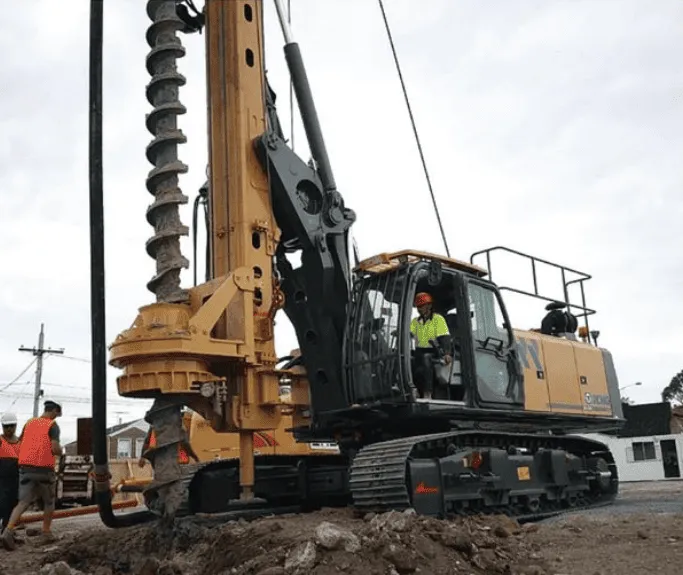
What Is an Auger Cast Pile?
An auger cast pile is produced using a continuous flight auger with a hollow central stem. The auger drills into the ground while carrying excavated soil upward along the flights.
Once the required depth is reached, grout or concrete is pumped through the hollow stem. The auger is then withdrawn at a controlled rate while the cementitious material fills the space created by the removed auger.
The pile is formed underground without leaving the borehole open during the main installation stage.
Depending on the project design, reinforcement can be installed after concrete placement. A reinforcing cage may be lowered or pushed into the fresh cementitious material while it remains workable.
The basic sequence is:
Drill → Reach design depth → Pump grout/concrete → Withdraw auger → Install reinforcement → Complete pile
This sequence makes the drilling equipment, auger configuration, pumping system, and withdrawal rate closely connected to pile quality.
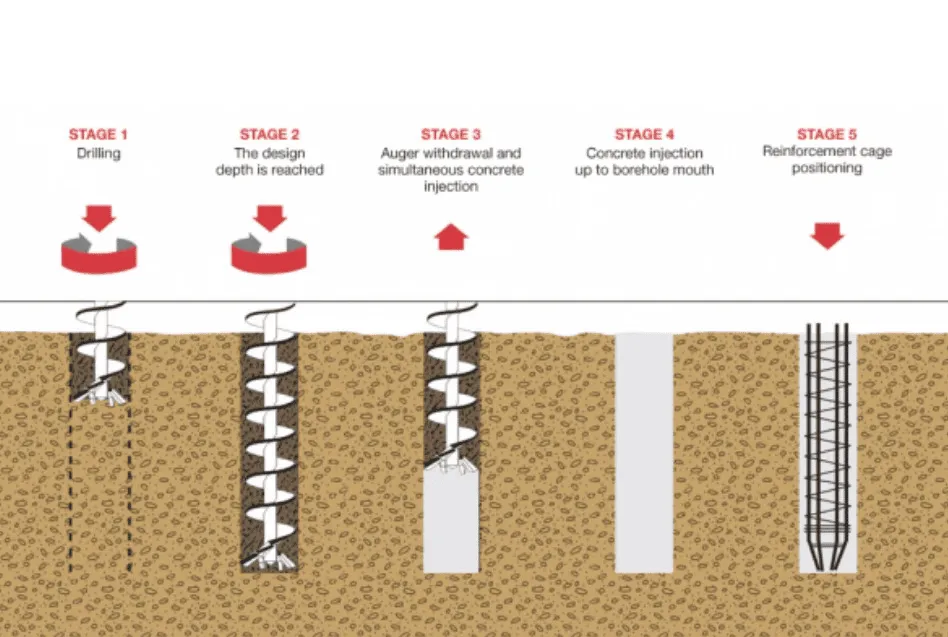
How Does Auger Cast Pile Construction Work?
1. Site and pile position preparation
Before drilling begins, the contractor establishes the pile locations and checks the working platform, access conditions, underground utilities, and equipment clearance.
The drilling rig must be positioned accurately because pile location affects the final foundation layout.
2. Continuous flight auger drilling
The rig rotates the continuous flight auger while applying downward force. The auger flights cut into the soil and transport the excavated material toward the surface.
Because the auger remains in the ground throughout drilling, the surrounding soil provides support around the drilled section.
The required auger diameter and configuration depend on the pile diameter, soil conditions, drilling depth, and rig capacity.
3. Reaching the design depth
The auger continues drilling until it reaches the specified pile toe elevation.
During this stage, the operator monitors drilling resistance, torque, penetration rate, depth, and other machine parameters. Changes in drilling resistance can provide useful information about variations in the ground profile.
4. Pumping grout or concrete
Once the auger reaches the required depth, cementitious material is pumped through the hollow stem.
The material exits near the cutting head at the bottom of the auger.
This creates pressure at the pile toe and fills the space as the auger is withdrawn.
5. Controlled auger withdrawal
The auger is lifted while cementitious material continues to be pumped.
The withdrawal speed must be coordinated with the pumping rate. Pulling the auger too quickly can reduce the amount of material placed around the pile shaft, while excessive pumping can increase material consumption and ground heave.
For this reason, concrete or grout volume, pump pressure, auger depth, rotation, and withdrawal rate are important construction parameters.
6. Reinforcement installation
After the pile material has been placed, reinforcement can be installed while the material is still workable.
Depending on the design, contractors may use a full-length reinforcing cage, partial reinforcement, or individual reinforcement elements.
The installation method needs to account for pile diameter, cage length, reinforcement weight, and material workability.
Equipment Used for Auger Cast Pile Construction
An auger cast pile operation normally requires several pieces of equipment working together.
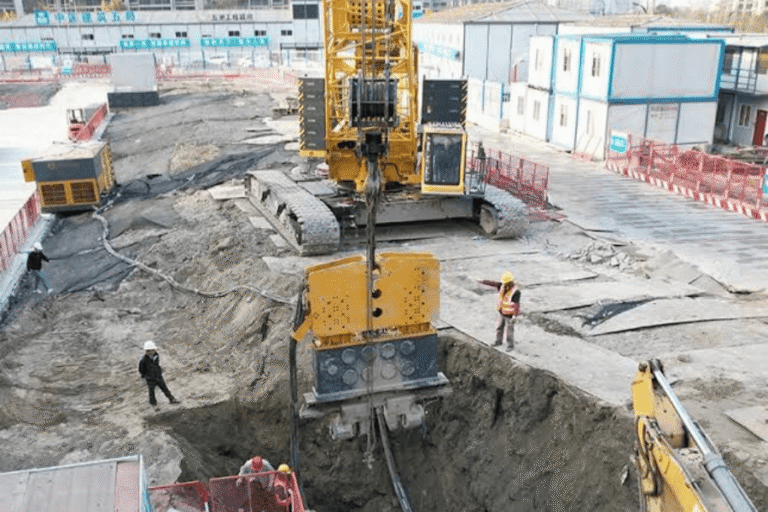
CFA Drilling Rig
The drilling rig provides the rotation, crowd force, and lifting capacity required to operate the continuous flight auger.
Rig selection depends on:
- Required drilling depth
- Pile diameter
- Ground conditions
- Required torque
- Auger length
- Project access and headroom
For projects with difficult access or restricted working areas, equipment dimensions can be just as important as drilling capacity.
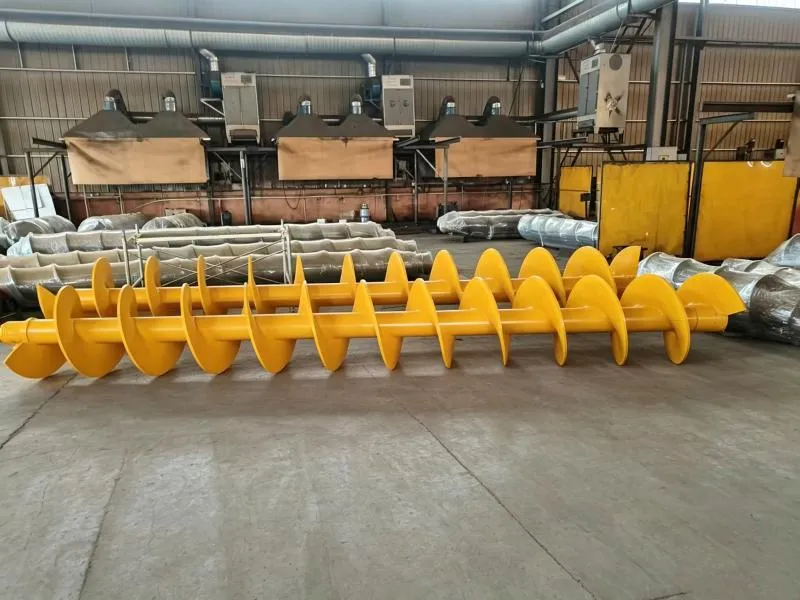
Continuous Flight Auger
The continuous flight auger is the primary drilling tool.
It consists of a central hollow shaft with helical flights welded or assembled along its length. The cutting arrangement at the bottom is selected according to the ground being drilled.
Different tooth configurations may be used for:
- Clay
- Sand
- Gravel
- Mixed formations
- Weathered rock
The auger diameter determines the nominal pile diameter, while its flight configuration affects spoil removal and drilling performance.
Auger Teeth
Auger teeth are the cutting components mounted at the bottom of a CFA auger and are selected according to the ground formation. Soil teeth are suitable for clay, sand, and general soft-to-medium soil, while Bullet teeth are better suited to gravel, cobbles, and harder inclusions.
For example, soil teeth can provide faster penetration in cohesive soil, while wear-resistant teeth help maintain cutting performance in abrasive ground. Worn or damaged teeth can increase drilling torque and reduce penetration efficiency, so they should be checked and replaced when necessary.
Concrete or Grout Pump
The pumping system delivers cementitious material through the hollow stem.
The pump must provide sufficient flow and pressure for the required pile diameter and depth. Pump performance also needs to remain stable during auger withdrawal.
The pump, delivery line, swivel, and hollow-stem connection form a continuous material delivery system from the batching area to the pile.
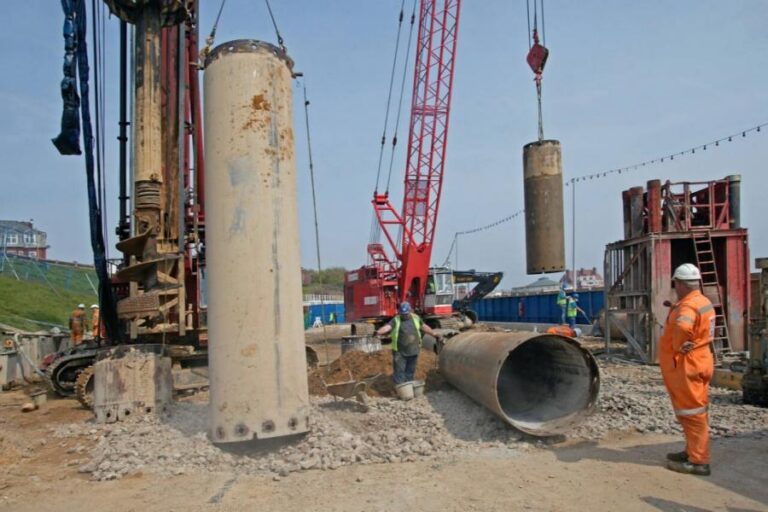
Reinforcement Handling Equipment
Where reinforcement cages are required, additional equipment may be used to lift and guide the cage into the freshly placed material.
For long cages, contractors need to consider cage stiffness, lifting points, installation depth, and the setting characteristics of the cementitious material.
What Materials Are Used in Auger Cast Piles?
The cementitious material used for an auger cast pile depends on the project specification.
Common materials include:
- Cement grout
- Sand-cement grout
- Flowable concrete
- Cementitious grout with admixtures
The mix needs to remain pumpable while providing the required strength after curing.
Material selection can affect pumping pressure, placement rate, reinforcement installation, and final pile performance.
For projects requiring reinforcement cages, the mix must also provide sufficient workability to allow the cage to reach the specified depth without excessive deformation or obstruction.
Auger Cast Pile vs. CFA Pile
The terms auger cast pile and CFA pile are often used interchangeably, particularly when describing the same type of hollow-stem continuous flight auger installation.
CFA stands for Continuous Flight Auger, referring to the drilling system used to create the pile.
Auger Cast Pile and ACIP (Auger Cast-in-Place Pile) describe the pile installation method in which cementitious material is placed through the hollow auger as it is withdrawn.
In North American foundation work, Auger Cast Pile, ACIP Pile, and CFA Pile can therefore refer to closely related construction methods.
The terminology may vary between contractors, engineers, specifications, and geographic markets, so the project specification should be used to determine the exact installation requirements.
Where Are Auger Cast Piles Used?
Auger cast piles are suitable for many foundation projects where drilled deep foundations are required.
Typical applications include:
Commercial Buildings
They can be used to transfer building loads through weak near-surface soils into deeper bearing layers.
Industrial Facilities
Industrial projects may require deep foundations for structures, equipment foundations, tanks, and process facilities.
Transportation Infrastructure
Auger cast piles can be used for foundations associated with bridges, retaining structures, sound walls, and other transportation-related construction.
Retaining and Structural Support
Closely spaced piles can be incorporated into certain earth-retention and structural support systems, depending on the engineering design and site conditions.
Projects Near Existing Structures
Because the method does not require maintaining a large open borehole, it can be useful where nearby structures, utilities, or site constraints make conventional open-hole drilling less suitable.
Advantages of Auger Cast Pile Construction
One of the main advantages is the continuous nature of the installation process.
The contractor can drill and place the pile material during the same operation, reducing the number of separate steps compared with some conventional drilled-pile methods.
Other potential advantages include:
- Fast pile installation
- No open borehole during the main placement process
- Reduced exposure of the borehole to unstable soil
- Suitable for many soft to medium ground conditions
- Good adaptability to urban construction sites
- Continuous monitoring of drilling and placement parameters
- Reduced need for temporary casing in suitable ground conditions
The actual performance depends on soil conditions, pile design, equipment selection, and construction control.
Limitations and Construction Challenges
Auger cast piling is not suitable for every ground condition.
Hard rock, large cobbles, boulders, very dense formations, and severe obstructions can make continuous auger drilling difficult.
Another challenge is controlling the relationship between auger withdrawal speed and material delivery rate.
If the auger is withdrawn faster than the material can replace the drilled volume, defects or reduced pile diameter may occur. Excessive material pressure or uncontrolled placement can create ground heave or excessive grout consumption.
Groundwater, loose granular soils, underground obstructions, and significant changes in soil strength also require careful planning.
For this reason, equipment selection should be based on actual geotechnical information rather than pile diameter alone.
How to Select an Auger for Auger Cast Piling
The auger should be selected according to the pile design and ground conditions.
Important factors include:
Pile diameter:
The auger diameter should correspond to the specified pile diameter and installation method.
Drilling depth:
The auger length and rig mast must accommodate the required drilling depth.
Soil formation:
Cutting teeth and flight configuration should match the expected soil and inclusions.
Rig torque:
The drilling rig must provide sufficient torque to maintain penetration under the expected ground resistance.
Material delivery:
The hollow stem needs to provide an adequate flow path for the specified grout or concrete.
Wear resistance:
Projects involving abrasive sand, gravel, or mixed ground may require more durable cutting components.
For contractors working across different ground conditions, interchangeable auger teeth can make maintenance and tooling changes easier during the project.
Auger Cast Pile Quality Control
Quality control starts during drilling and continues through material placement.
Important records may include:
- Pile location
- Final drilling depth
- Drilling time
- Auger torque
- Penetration rate
- Pump pressure
- Material volume
- Auger withdrawal rate
- Cementitious material properties
- Reinforcement installation depth
Comparing the theoretical pile volume with the actual material consumption can also help identify unusual placement conditions.
For example, significantly higher material consumption may indicate enlarged sections, loose ground, cavities, or other subsurface conditions.
Maintaining consistent drilling and placement records provides useful information for evaluating pile installation quality.
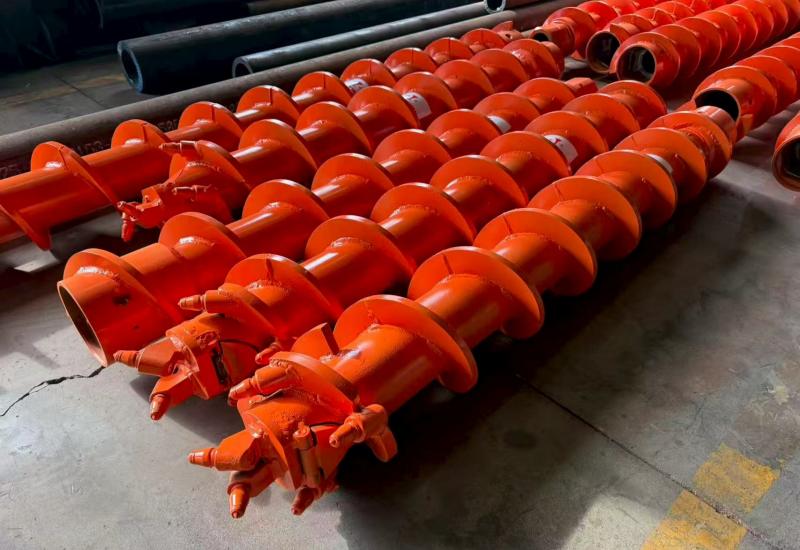
Choosing the Right Auger Teeth for Ground Conditions
The cutting teeth are small components, but their condition directly affects drilling performance.
For cohesive soils, soil teeth with a geometry designed for efficient soil cutting can help maintain penetration.
For abrasive formations containing gravel or hard inclusions, carbide-enhanced teeth may provide better wear resistance.
Before selecting teeth, contractors should consider:
- Soil classification
- Gravel and cobble content
- Abrasiveness
- Expected drilling depth
- Required drilling speed
- Tooth holder configuration
- Ease of replacement
A suitable combination of CFA auger, cutting teeth, drilling rig, and concrete pumping system helps maintain a stable installation process throughout the piling operation.
Frequently Asked Questions(FAQ)
An auger cast pile is a deep foundation pile constructed using a hollow-stem continuous flight auger. Grout or concrete is pumped through the auger as it is withdrawn, forming the pile in place.
They are closely related and often refer to the same construction method. CFA pile emphasizes the use of a Continuous Flight Auger, while Auger Cast Pile or ACIP pile describes the cast-in-place pile formed during auger withdrawal.
Typical equipment includes a CFA drilling rig, continuous flight auger, auger teeth, grout or concrete pump, delivery lines, and equipment for installing reinforcement cages.
Auger cast piles are commonly used in clay, sand, silt, and mixed soils. Ground containing large cobbles, boulders, or hard rock may require specialized tooling or another drilling method.
Auger teeth should be selected according to the ground formation. Soil teeth are generally suitable for clay and sand, while carbide-tipped or more wear-resistant teeth are better suited to gravel, cobbles, and harder inclusions.